What Germans actually eat at Oktoberfest
A guide to what's actually served at Munich's Oktoberfest, and what it all means.
The Oktoberfest menu that exists in the rest of the world is fairly consistent: bratwurst, sauerkraut, a pretzel, and something involving mustard. It's a perfectly good dinner. It's just not what's being eaten in Munich.
What's actually served on the Theresienwiese is a specific regional cuisine with its own internal logic — food designed to be eaten in enormous quantities, at a long shared table, mostly with your hands, alongside a liter of beer. Once you see that logic, the menu stops looking random.
Here's the whole thing, dish by dish. For the drink side and the festival's history, start with our guide to Oktoberfest food and drink.
Hendl: the dish the festival runs on
If you eat one thing at Oktoberfest, it's this.
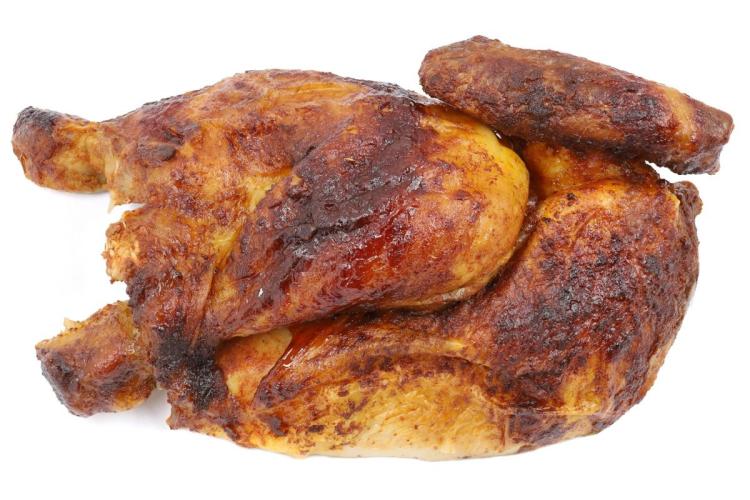
Hendl is roast chicken, sold as a half bird, rubbed with butter and salt and often parsley, and turned slowly on rotisseries until the skin goes deep gold and audibly crisp. It arrives on paper or a small board, sometimes with a pretzel, and you eat it with your hands. There is no elegant way to do this and nobody attempts one.
Chicken took over the festival for reasons that are entirely practical. It cooks fast and it cooks in view, which means the roasteries are their own advertisement — you can smell them from several rows away and see the birds turning in racks of dozens. It's cheap enough to serve at volume without being thin. And crucially, it holds up to being eaten in a crowd with no cutlery, at a table you're sharing with eleven strangers, one-handed, because the other hand has a beer in it.
Chicken roasteries appeared at the Wiesn from the 1880s onward and never left. Long before that, roast fowl had been festival food across southern Germany, the kind of thing you ate at a fair rather than at home. What changed was scale: the modern rotisserie turned an occasional treat into the festival's staple.
A good one has skin that shatters slightly and meat that's still juicy underneath, seasoned simply. There's no sauce and no glaze. It doesn't need either.
Steckerlfisch: fish on a stick
The other great open-fire dish, and the one that surprises visitors most.
A whole mackerel — sometimes trout or char — is threaded lengthwise onto a wooden stake, brushed with oil and salt and occasionally herbs, and stood upright in rows leaning over a long charcoal trench. The fish cook slowly, skin blistering and blackening in patches, and are handed over still on the stick. You eat it standing up, working the flesh off the bones with your fingers.
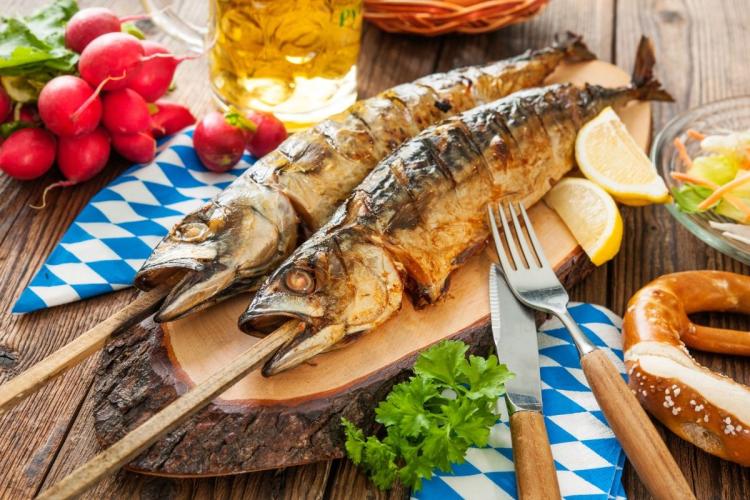
This isn't a festival invention. Bavaria has a great many lakes and rivers, and grilling fish on a stake at the water's edge is old lakeside and beer-garden practice that simply moved indoors to the fairground. Its natural home is a summer afternoon by the Starnberger See, not a beer tent, which is part of why it tastes like it belongs somewhere quieter.
The smell of the Steckerlfisch stands — oily smoke, salt, charcoal — is one of the two or three things people remember about the Wiesn years later.
The ox roast
One of the large tents is built around a spit-roasted ox, turning over a fire in full view of the room, and it has been doing this for well over a century.
The tent keeps a public tally of how many oxen it has served across the season, which tells you something about the spirit of the place. The plate itself is genuinely old-fashioned: sliced ox in a dark gravy with a bread dumpling, the sort of thing that would have been recognisable at a Bavarian fair two hundred years ago.
It's also the most theatrical food at the festival. The roasting is the point as much as the eating.
The pork, and the dumpling that comes with it
Two pork dishes get confused, and the difference is worth knowing before you order.
Schweinshaxe is the roasted knuckle: a whole joint with the bone in, the skin blistered into hard crackling, the meat underneath falling apart. It is enormous, it is meant to be, and it's the one that ends up in photographs.
Schweinsbraten is sliced roast pork with gravy, and it's what locals order more often. Less spectacle, better balance, and considerably easier to finish.
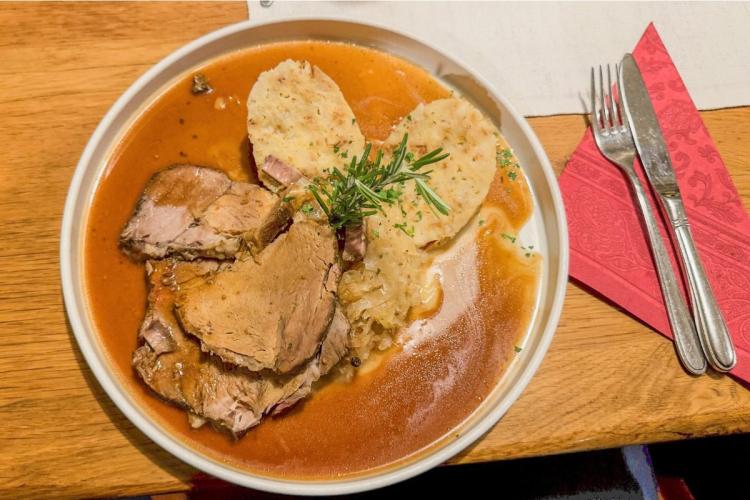
Both arrive with a Knödel — a dumpling, either bread-based or potato-based, roughly the size of a tennis ball. This is the main starch of Bavarian cooking and it's there to deal with the gravy. Visitors often ignore it. Don't; a good bread dumpling is one of the better things on the table.
Brezn: the pretzel, properly understood
The Bavarian pretzel and the American mall pretzel are related, but not closely.
The difference is lye. Before baking, Brezn are dipped briefly in an alkaline solution, which is what produces the dark mahogany surface, the thin crackling crust and the faint, pleasant bitterness underneath the salt. Without it you get bread in a pretzel shape.
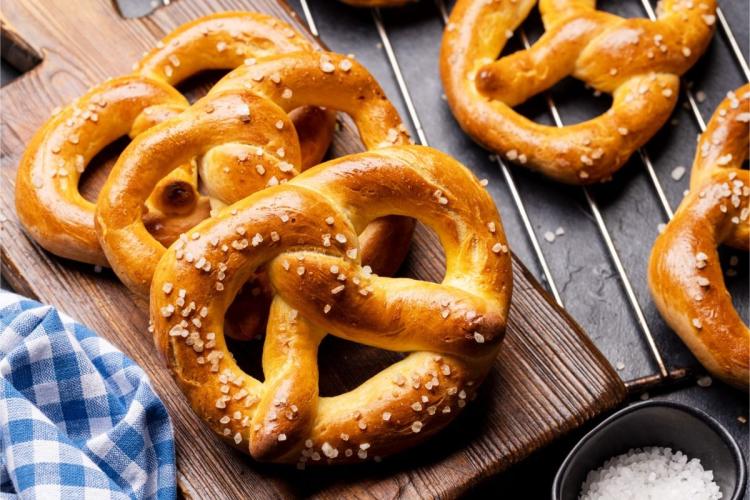
The shape matters too: thin crossed arms that bake up dry and crisp, and a fat belly that stays soft. The belly is the good part, and it's often split horizontally and buttered. At the festival they're sold considerably larger than a normal bakery Brezn — the size is faintly absurd and entirely deliberate.
They're at their best within hours of baking, and they go stale fast, which is why you buy one from the woman carrying a basket of them through the tent rather than planning ahead.
Brotzeit: the cold plate
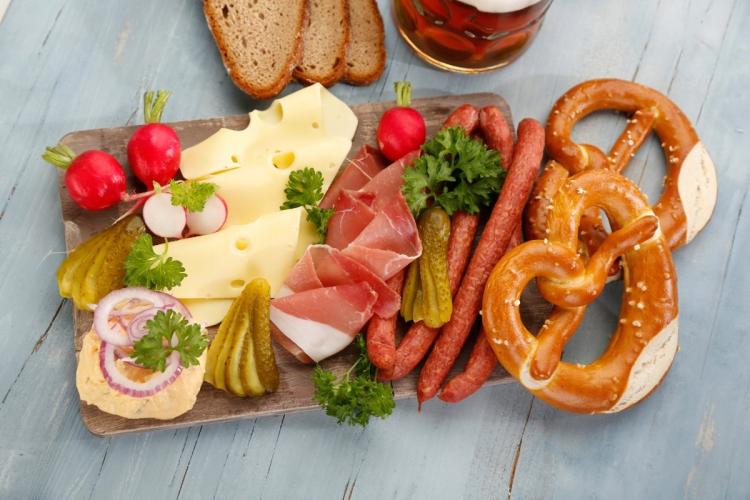
Several Oktoberfest items look random until you know the word Brotzeit — literally "bread time," the Bavarian cold snack eaten between meals or instead of one. It's bread, something spreadable, something sharp, something pickled, and beer. Once you see the pattern, the rest of the menu clicks into place.
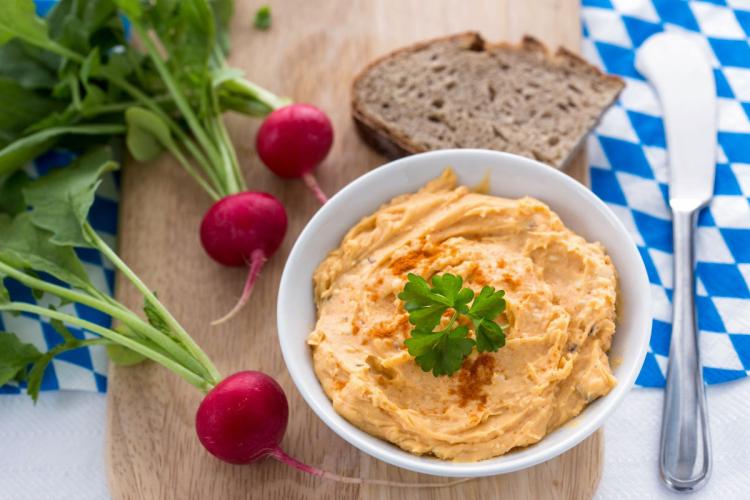
Obatzda is the centre of it: ripe Camembert mashed together with butter, sweet paprika, finely chopped onion, and often a splash of wheat beer, until it's soft, orange-pink and scoopable. It began as thrift — a way to use up cheese that had gone further than anyone wanted — and it's credited to a Bavarian beer garden in the 1920s, after which it spread across the region and never left. It's eaten with pretzel, and nothing else is required.
American readers will notice that it sounds like beer cheese. It isn't, and the two have very little in common beyond the presence of beer — we deal with that properly on the recipe page.
Radi is the detail that gives away how the festival works. A large white radish is peeled and cut in one long continuous spiral so it opens out like a concertina, then salted heavily and left to slump. The salt draws out water, softens the raw bite, and leaves the slices peppery and very savoury. It also makes you extremely thirsty, which sells more beer. Nobody involved is being coy about this.
Radieserl, small red radishes served whole with salt, are the everyday cousin and appear on the same plate.
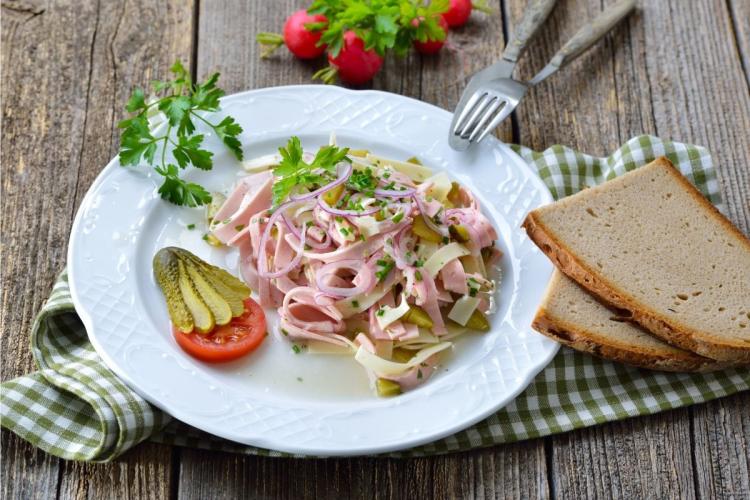
Wurstsalat is where sausage genuinely belongs in Bavarian eating: sliced cold, dressed with vinegar, oil and raw onion, sharp and refreshing rather than heavy. It's a far better match for a liter of lager than anything grilled.
Sweets, almonds, and hearts nobody eats
Step outside the tents and the festival turns into a fairground, with its own separate menu.
Kaiserschmarrn is the dessert worth queuing for: a thick pancake torn into rough pieces as it cooks so the edges caramelise, then buried under powdered sugar and served with stewed plums or apple sauce. The name translates roughly as "the emperor's mess," which is fair to look at and unfair to eat. It's Austrian in origin and entirely at home in Bavaria.
Gebrannte Mandeln are almonds caramelised in sugar in wide copper pans, stirred in the open air. The smell carries across the whole fairground and does most of the selling.
Lebkuchenherzen deserve a paragraph precisely because they aren't really food. These are the large gingerbread hearts, iced with piped messages — affectionate, teasing, occasionally rude — and hung on ribbons. They're bought as gifts, worn around the neck all day, taken home, and in most cases never eaten at all. They go rock hard within days and end up on a wall. It's one of the few festival traditions that's entirely about giving something rather than consuming it.
Where sausage and sauerkraut actually fit
None of this means the traditional party menu is invented. Bratwurst is sold and eaten at the Wiesn, sauerkraut appears alongside pork, and both are genuinely Bavarian. They're simply supporting players rather than the headline.
The one thing worth correcting properly is Weisswurst, the pale veal-and-pork sausage that's a Munich institution. It is not festival food — it's breakfast. Traditionally it's eaten before noon, gently poached rather than grilled, with sweet mustard and a pretzel, and the skin is left behind rather than eaten. Putting Weisswurst on an evening Oktoberfest menu is the single most common mistake in English-language party guides. If you want it, have it in the morning, which is exactly what Munich does.
Eating at the Wiesn without meat
This is a meat-heavy festival, and it would be dishonest to pretend otherwise. It isn't an impossible one.
Käsespätzle — soft egg noodles layered with melted cheese and topped with fried onions — is widely available and genuinely good. Beyond that: Obatzda with a pretzel, Radi, potato salad, Knödel, Kaiserschmarrn, and the almond and gingerbread stands outside. Anyone eating fish has the Steckerlfisch, which is arguably the best thing on the grounds anyway.
How to order it, and how to eat it
Food comes from your table's server rather than a counter, so you sit first and order second. Portions are large, sharing is normal, and nobody will look twice if three people split a Haxe. Hands are expected for Hendl and Brezn. Cash is still widely preferred.
And if you're recreating any of this at home, the guiding principle is the one the festival itself follows: cook something big and simple, put it in the middle of the table, and let people get on with it. The Oktoberfest food and drink guide has a full plan for doing that for eight people, and for the beer to pour alongside it, see beer in Germany.