
Gazelle horns (almond cookies)
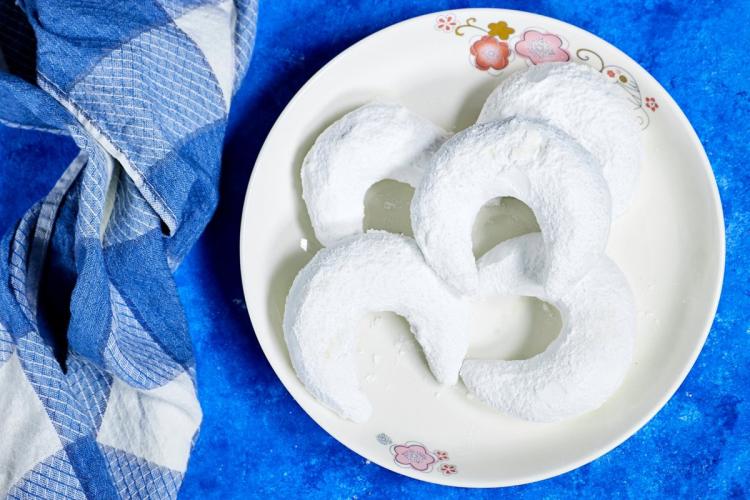
Delicate crescent-shaped pastries with a paper-thin, orange blossom dough wrapped around a fragrant almond and cinnamon paste. They are tender, lightly sweet and dusted with powdered sugar, and traditionally served with mint tea or coffee.
Ingredients
Instructions
Put the flour, melted butter, egg yolk, orange blossom water and water in a food processor and blend until the dough comes together, firm but smooth. If it is too stiff, add a little more water, a teaspoon at a time. Turn it onto a clean surface and knead well. Cut the dough in half, wrap each piece in plastic and let it rest for 20 minutes.
Meanwhile, make the filling. Mix the ground almonds, confectioners’ sugar, melted butter, orange blossom water, cinnamon and almond extract in a bowl with a spatula until you have a uniform paste. If it is crumbly, work in about half of the beaten egg white and keep the rest for sealing.
Unwrap the dough. With oiled hands, shape it into about 30 balls the size of a walnut and set them on a tray. Preheat the oven to 400°F (200°C).
On a lightly floured surface, roll out each ball as thinly as you can into a rectangle about 3 by 4 inches. Put 1 tablespoon of filling in the center. Brush the edges with beaten egg white, fold the dough over the filling and press firmly to seal. Curve the cookie into a crescent and twist the two tips slightly upward, like horns.
Place the cookies on a baking sheet and bake for about 15 minutes, checking from 12 minutes on, until pale golden. Transfer them while hot to a cool surface, such as a marble slab or a rack, and dust generously with confectioners’ sugar. Let them cool completely before serving.
Notes
Roll the dough as thin as you can without tearing: the delicate shell around the soft almond filling is what makes these cookies special. Keep the dough you are not using wrapped, as it dries quickly.
Seal the edges well. If the filling leaks in the oven, press the seam again with your fingertips next time and use a little more egg white.
Eat them the same day for the best texture, or store them in an airtight container at room temperature. They also freeze well.
Variations
Shape them as a horseshoe and press an unpeeled almond in the middle instead of a crescent.
Use date paste in place of part of the almond filling, as in some Maghrebi versions.
Skip the powdered sugar for a plainer cookie, or brush with a light orange blossom water glaze.
Source
Cuisine: Moroccan cuisine.
Kaab el ghazal (كعب الغزال) is a classic pastry of the Maghreb, best known in Morocco, where it is often described as a Fassi, or Fez, specialty adopted across the country. The name is often translated as “gazelle horns,” after the French cornes de gazelle and the curved shape, though kaab more literally means “heel” or “ankle,” so it can also be understood as “gazelle’s heel.”
The cookie is old. A 13th-century cookbook from the Muslim West, by Ibn Razīn al-Tujībī, already describes a similar pastry, with a dough of flour, olive oil, hot water and salt and a filling of almonds and sugar. Today the dough is typically scented with orange blossom water and the almond paste with cinnamon.
Gazelle horns are a sweet for celebrations. They are traditionally made for Eid al-Fitr, the feast that ends Ramadan, and in some accounts for weddings, and Moroccan pastry shops sell them all year round. A cousin of the pastry exists in neighboring Algeria, where it is known as tcharek, and a French version, cornes de gazelle, is also common.