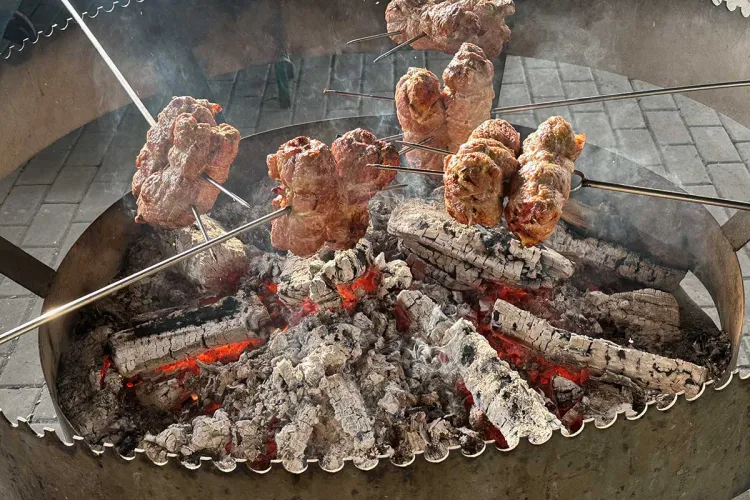
You stand around the grill with a beer and a piece of bread, turning the meat every ten or fifteen minutes, watching the outside caramelise slowly in the smoke. Nobody is in a hurry. The fire has been going for a while and the embers are exactly where they need to be. Dinner will be ready in an hour, and the hour is part of the meal.
Schaschlik is not a quick barbecue. It is a particular kind of German outdoor gathering, unhurried, fire-centred, and built around a piece of meat substantial enough that most people cannot quite finish it. If you have encountered it at all, it was probably as a small pork skewer at a German Christmas market or summer fair. That version exists and is perfectly good. But the one worth knowing about is the larger, less famous cousin: the Schaschlik-Rolle, a full roll of pork, bacon, and cabbage, slow-cooked over charcoal until the outside is deeply lacquered and the inside falls apart.
From the Caucasus to the DDR
The word Schaschlik comes from Crimean Tatar, and the dish itself belongs to a vast family of skewered, fire-grilled meats that runs from Georgia and Armenia through Central Asia and into Russia. Simple in concept: good meat, a marinade, an open fire, it spread westward through the Soviet Union during the 20th century, becoming a staple of outdoor cooking across the Eastern Bloc.
In East Germany, the DDR, Schaschlik arrived as one of the few reliably available grilled meat dishes at public events, funfairs, and outdoor markets. Small cubes of marinated pork on metal skewers, cooked over charcoal, became embedded in East German food culture in a way that survived reunification and gradually spread westward. Today it is eaten across Germany, at garden parties and street festivals and on the long tables of club outings, entirely naturalised and no longer particularly associated with its origins.
What Germany added to the recipe was distinctly its own. Bacon and cabbage, two ingredients as Central European as anything in the kitchen, wound up inside the roll, giving the pork a basting layer of fat and a filling of softened, smoky vegetable that has no equivalent in the Caucasian original. The large-format roll version, substantial enough to serve as a meal on its own, belongs to the German chapter of the story rather than the Caucasian one.
The roll, not the skewer
The street version of Schaschlik is a handful of pork cubes on a single skewer, cooked quickly and eaten from the stick. The Schaschlik-Rolle is something else entirely. Thin slices of pork collar are marinated in oil, vinegar, paprika, onion, and garlic, then laid out in an overlapping sheet and layered with streaky bacon and finely shredded cabbage. The whole thing is rolled tightly, pushed through with two heavy metal skewers to hold the shape, and placed over a charcoal fire to cook slowly for about an hour.
The result at the table, if you can call the space around a mangal grill a table , is a piece of meat roughly the size and weight of a small roast. The exterior is caramelised to a deep, glistening brown, lacquered with rendered bacon fat. Inside, the pork is tender and moist, the cabbage has all but disappeared into the meat, and the bacon has done its work as both flavouring and basting agent throughout the cook. It is a generous thing. Most people cannot finish it, and that is considered a good outcome.
The fire is the point
Schaschlik-Rolle is cooked on a mangal: a deep, oval metal bowl on legs, filled with charcoal, with the skewers resting across the rim above the embers. The mangal is common across Germany, Eastern Europe, and the Middle East, and its design is not incidental. The depth of the bowl contains and concentrates the heat; the scalloped rim holds the skewers at the right height above the embers; and the whole thing is built for the long, low, even heat that this kind of cooking requires.
What it is not built for is speed. The Schaschlik-Rolle needs charcoal embers, not flames, the fire must be allowed to burn down to a steady, grey-ashed glow before the meat goes on. Then the hour begins. You turn the rolls every ten or fifteen minutes, which is frequent enough to keep the cooking even and infrequent enough to allow real conversations between turns. The beer helps. The bread, torn and passed around, helps more.
This is why Schaschlik-Rolle functions as a social occasion as much as a meal. The cooking itself is the gathering. By the time the meat comes off the grill, everyone has been standing around the fire for the better part of an hour, talking, eating bread, watching the caramelisation develop. Dinner, when it finally arrives, feels earned.
What comes with it
The traditional accompaniments to a Schaschlik feast are bread, German beer, and at least two salads. The salad question in Germany is never simple: the country is split along a north-south fault line on the matter of potato salad that is taken more seriously than it might appear. The northern version is bound with mayonnaise, enriched with hard-boiled eggs and gherkin, made the day before and served cold. The southern, Swabian version is dressed with warm vinegar and broth while the potatoes are still hot, allowed to rest to room temperature, and contains neither egg nor mayonnaise. Serving both at the same table is either diplomatic or greedy, depending on your perspective, and is exactly what a Schaschlik feast calls for.
Alongside the potato salads, a raw white cabbage salad, finely shredded, salted, squeezed, and dressed simply with vinegar and oil provides the sharp, clean counterpoint to the richness of the meat. The bread soaks up the juices. The beer cuts through the fat. Nothing about the combination is complicated, and nothing about it needs to be.
Make it yourself
The full spread is more achievable at home than it looks. The two potato salads and the cabbage salad can all be made ahead, the northern potato salad is actually better the next day — leaving the day itself entirely free for the fire, the beer, and the company.
- Schaschlik-Rolle — The large-format pork roll, marinated and slow-cooked over charcoal. Allow 2 hours for marinating and 1 hour at the grill.
- Northern German potato salad — Mayonnaise, egg, and gherkin. Make the day before.
- Swabian potato salad — Vinegar and broth, no mayo, room temperature. Make on the day.
- German raw cabbage salad — Sharp, light, and quick. Make a few hours ahead.