Every year on 25 January, people around the world gather to raise a glass, share a meal, and celebrate the life and poetry of Robert Burns, Scotland’s beloved national bard. Born on this date in 1759 in Alloway, Ayrshire, Burns left behind a legacy of verse that continues to resonate across centuries and continents. Burns Night has become one of Scotland’s most cherished cultural traditions, a winter gathering that combines literature, food, and fellowship in equal measure.
Most celebrations take place on the evening of 25 January itself, though many hosts choose the nearest Friday or Saturday when that makes gathering easier. What began as a small memorial dinner among friends has grown into a global phenomenon, with Burns suppers held not only across Scotland but also in England, North America, Europe, Australasia, and anywhere Scottish communities or poetry enthusiasts have put down roots.
- Date: 25 January (or the nearest weekend)
- Purpose: Celebrating the birth, life, and works of Robert Burns
- Global reach: Burns suppers take place in dozens of countries worldwide
- Key distinction: “Burns Night” refers to the date itself, while a “burns supper” describes the ceremonial meal and programme held on or around that date
Robert Burns: the man behind the celebration
Robert Burns came into the world on 25 January 1759 in a small cottage in Alloway, Ayrshire, and departed it far too soon on 21 July 1796 in Dumfries, aged just 37. In those brief decades, he produced over 550 poems and songs, earning himself the title of Scotland’s national bard. His background was humble—a farmer’s son who worked the land, later taking up a post as an exciseman, yet his literary gifts were extraordinary.
Burns wrote in Scots, English, and a fluid blend of both, capturing the rhythms of everyday speech and the emotions of ordinary people. His themes ranged from romantic love to social justice, from drinking songs to sympathy for the poor and oppressed. This combination of accessible language and universal themes explains why his work remains so beloved.
- Birth: 25 January 1759, Alloway, Ayrshire
- Death: 21 July 1796, Dumfries (aged 37)
- Output: Over 550 poems and songs
- Key works often heard on Burns Night: “Auld Lang Syne”, “Tam o’ Shanter”, “Address to a Haggis”, “A Red, Red Rose”, “Scots Wha Hae”, “To a Mouse”
- First memorial dinner: 21 July 1801, at Burns Cottage in Alloway, on the fifth anniversary of his death
- Transition to birthday celebration: The following year, friends moved the gathering to his birthday, establishing the Burns Night tradition
The origins and history of the Burns Supper
The first Burns supper was not actually held on the poet’s birthday at all. On 21 July 1801, nine of Burns’s close friends gathered at Burns Cottage in Alloway to mark the fifth anniversary of his death. They shared a meal that included haggis, read aloud from his works, and made speeches celebrating his life and genius. It was, by all accounts, such a dinner that they resolved to meet again, this time on his birthday rather than the anniversary of his passing.
The Greenock Burns Club, founded in 1801 by Ayrshire-born merchants, is considered the first still-extant Burns club. They held their initial birthday celebration on 29 January 1802, only to discover the following year, after consulting parish records, that Burns was actually born on 25 January. From 1803 onward, the date was corrected, and Burns Night settled into its now-familiar calendar slot.
By the mid-19th century, Burns clubs had multiplied across Scotland and beyond. Glasgow, Edinburgh, London, Montreal, New York, and Melbourne all boasted active groups hosting annual suppers. The Robert Burns World Federation, established in 1885, helped standardise certain elements of the evening while still allowing for local variations and personal touches.
Key milestones in Burns Night history
| Year | Event |
|---|---|
| 1759 | Robert Burns born, 25 January, Alloway |
| 1796 | Burns dies, 21 July, Dumfries |
| 1801 | First commemorative supper held on fifth anniversary of death |
| 1801 | Greenock Burns Club founded |
| 1802 | First birthday supper (mistakenly on 29 January) |
| 1803 | Date corrected to 25 January |
| 1885 | Robert Burns World Federation established |
Traditional running order of a Burns Night supper
A formal Burns Night supper follows a well-established sequence, almost like a carefully choreographed performance. While informal family versions might include only a few core elements like haggis, a toast, and perhaps one favourite poem, Burns clubs and formal dinners adhere to a stricter order. Understanding this structure helps both hosts and guests appreciate the rhythm of the evening.
The typical sequence unfolds as follows:
- Guests arrive and gather, often in tartan dress
- Host’s welcome and introduction of guests
- Grace (usually the Selkirk Grace)
- Starter course (often Scotch broth or another traditional soup)
- Piping in of the haggis
- Recitation of “Address to a Haggis” and the ceremonial cutting
- Toast to the haggis
- Main course: haggis with neeps and tatties
- Dessert and coffee
- “Immortal Memory” speech
- “Toast to the Lassies”
- “Reply from the Lassies”
- Readings and songs from Burns’s work
- Vote of Thanks
- Closing with “Auld Lang Syne”
Some suppers add extras such as Scottish music performances, Scottish country dancing, or a full cèilidh after the formal programme. The beauty of Burns Night lies in its flexibility—the tradition provides a framework that hosts can adapt to their circumstances.
Host’s welcome, grace and the opening courses
The evening begins with the host or chair welcoming everyone and stating the purpose of the gathering. At formal dinners, this might include introducing the top table or acknowledging special guests. The atmosphere is warm but measured at this stage, guests are settling in, finding their places, and preparing for the theatrical moments to come.
Once everyone is seated, grace is said before the first course. The most commonly used is the Selkirk Grace, a brief thanksgiving often attributed to Burns himself, though it existed earlier as the “Galloway Grace” or “Covenanters’ Grace.” Burns recited a version during an 1794 visit to the Earl of Selkirk’s home and later published it, giving it the name by which it is known today. The prayer is short and heartfelt, perfectly suited to opening a grateful prayer over a communal meal.
The starter course that follows is typically a warming Scottish soup. Popular choices include:
- Scotch broth (a hearty lamb and vegetable soup)
- Cullen skink (smoked haddock chowder)
- Cock-a-leekie (chicken and leek soup, sometimes with prunes)
- Simple potato and leek soup
This calm opening allows guests to settle before the dramatic haggis entrance.
Piping in and Address to the Haggis
Here comes the theatrical heart of any successful Burns Night. The lights may dim, and guests rise to their feet as the piper leads the procession into the room. The tune might be “Scotland the Brave” or “A Man’s a Man for A’ That”—either way, the sound of bagpipes fills the space and signals that something special is about to happen.
The procession moves through the room with the piper in front, followed by the haggis carried on a silver platter (often by the chef), with the person who will deliver the address bringing up the rear. The guests clap along or simply watch as this glorious sight makes its way to the top table.
Once the haggis is in place and whisky has been poured, the reader launches into Burns’s famous “Address to a Haggis.” The poem opens with the immortal line “Fair fa’ your honest, sonsie face, Great chieftain o’ the puddin’-race!” and builds through eight stanzas of praise for this humble dish. The Scots language rings out—lines about gushing entrails bright, about how the warm reekin steam rises from the dish, about how those haggis fed grow sturdy and strong.
The climactic moment arrives with the words “An’ cut you up wi’ ready slicht”—at which point the speaker produces a knife, see rustic labour dicht (as Burns puts it), and dramatically slashes open the haggis casing. The gushing entrails bright spill forth, and while thro your pores the dainties creep, the room erupts in appreciation. At the final line, guests raise their glasses and toast the haggis with a hearty cheer. It is theatre, it is tradition, and it is utterly Scottish.
Main course and traditional menu
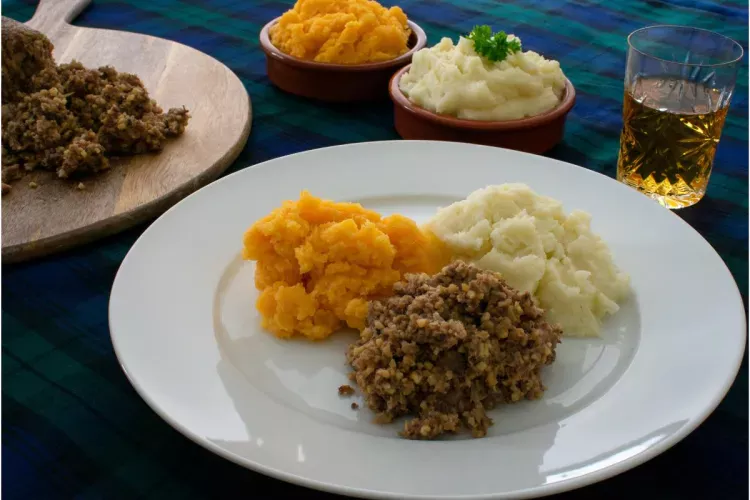
The main course of any Burns Night supper is, of course, haggis with neeps and tatties. The mashed rutabaga (or mashed swede) and mashed potato provide the perfect accompaniment to the rich, savoury haggis. The combination is comfort food at its finest, hearty, warming, and deeply satisfying on a cold January evening.
Modern hosts have plenty of options for accommodating different dietary needs. Vegetarian and vegan haggis have become widely available and surprisingly tasty. Some serve haggis bonbons as a starter, while others prepare haggis-stuffed chicken (sometimes called “Balmoral chicken”) for those who want a twist on tradition. A whisky sauce or whisky cream sauce draped over the haggis adds another layer of indulgence.
Traditional accompaniments and options
- Classic trio: haggis, neeps (mashed swede), and tatties (mashed potatoes)
- Vegetarian or vegan haggis for non-meat eaters
- Seasonal greens such as cabbage or kale
- Whisky cream sauce or good gravy
- Oatcakes on the side
Popular desserts
- Cranachan (cream, raspberries, toasted oats, whisky, and honey)
- Clootie dumpling (a steamed fruit pudding)
- Tipsy laird (a Scottish trifle with whisky)
- Cheese board with oatcakes and chutney
Whisky is traditionally served in small measures throughout the evening, but water should always be available, and considerate hosts provide non-alcoholic options for those who prefer them. Those who do partake might enjoy knowing that Burns himself was no stranger to a dram, and those who canna eat the haggis for any reason can still raise a glass in good spirit.
Toasts, speeches and entertainment
Once the plates are cleared and the coffee poured, the evening moves into its most distinctive phase. The toasts, speeches, and performances that follow are what truly set a Burns Night apart from any other dinner party. This is where the immortal memory of Robert Burns comes alive through words, wit, and song.
The typical sequence at formal dinners includes the “Immortal Memory” speech, the “Toast to the Lassies,” the “Reply from the Lassies,” followed by readings of Burns’s poems, traditional songs, and perhaps a “Vote of Thanks.” Not every home celebration includes all of these (smaller gatherings might feature just a short toast and one favourite poem) but understanding the full programme helps hosts decide which elements to include.
The Immortal Memory
The centrepiece of the evening’s speeches is the “Immortal Memory,” a substantial address devoted entirely to Robert Burns—his life, his works, his character, and his continuing relevance. The speaker typically weaves together biography, anecdotes, quotations from poems and songs, and personal reflections on why the Bard still matters in the 21st century.
Reverend Hamilton Paul, who hosted some of the earliest Burns suppers in Ayr, is credited with delivering what may have been the first formal “Immortal Memory” speech. Then old master of ceremonies set a pattern that speakers have followed ever since: celebrate the man, share his words, and invite the audience to consider what he means to them.
A good “Immortal Memory” speech balances seriousness with humour. It might touch on Burns’s humble origins as a farmer’s son, his meteoric rise to literary fame, his time in Edinburgh society, and his later years working as an exciseman in Dumfries. It should quote liberally from his work—“A Man’s a Man for A’ That” for his egalitarian spirit, “To a Mouse” for his sympathy with all creatures, “Ae Fond Kiss” for his romantic heart.
The speech concludes with an invitation for all present to raise their glasses with the words: “To the Immortal Memory of Robert Burns!” The room drinks as one, honouring a man who died over two centuries ago but whose words still stretch an strive to reach us.
Toast to the Lassies and the Reply
The “Toast to the Lassies” has an interesting history. It began roughly 70 years ago as a simple thanks to the women present who had prepared the meal. Over time, it evolved into a light-hearted tribute to women in general, typically delivered by a male speaker’s view of the opposite sex, ideally with wit, warmth, and plenty of Burns quotations.
The toast works best when it is affectionate rather than crude. Burns wrote extensively about love—from the tender “My Love is Like a Red, Red Rose” to the bittersweet “Ae Fond Kiss”—and a skilled speaker will weave these references into observations about relationships, marriage, or the differences between men and women. The goal is gentle humour that the whole room can enjoy.
A female guest then delivers the “Reply from the Laddies” (sometimes called “Reply to the Laddies”), offering a good-humoured response. This might include playful commentary on male foibles, references to Burns’s own complicated love life, or observations about the poor devil of a man trying to navigate the world. The best replies match the toast in wit and warmth, creating a balanced exchange that celebrates both halves of the room.
When women present join in the laughter on both sides, you know the toasts have struck the right tone.
Readings, songs and optional extras
Burns Night is nothing without Burns’s actual words. Between and after the speeches, guests may take turns reciting favourite poems or performing songs from his remarkable catalogue. The Scots language comes alive in these performances, whether delivered by seasoned performers or nervous first-timers doing their best with unfamiliar vowels.
Popular poems for recitation
- “Tam o’ Shanter” (the tale of a man who sees witches dancing—thro bloody flood and trembling earth resounds)
- “Holy Willie’s Prayer” (a satirical monologue)
- “A Man’s a Man for A’ That” (Burns’s great egalitarian anthem)
- “To a Mouse” (where the trembling earth beneath the plough becomes a meditation on fate)
- “To a Louse” (social satire with ye fill the bill o fare)
Songs often performed
- “Ae Fond Kiss”
- “My Love is Like a Red, Red Rose”
- “Scots Wha Hae”
- “Green Grow the Rashes”
Some gatherings include Scottish music performed on fiddle, pipes, or guitar. Others add Scottish country dancing or a full cèilidh after the formal programme, with a caller teaching simple dances to those unfamiliar with the steps. Optional extras might include quizzes on Burns’s life, displays of manuscript reproductions, or short talks on the Scots language and its place in Scottish culture.
The key is variety, an evening that balances serious reflection with lively entertainment, giving everyone something to enjoy.
Vote of thanks and closing
As the evening winds down, someone—often the host or an appointed speaker—delivers a “Vote of Thanks.” This short speech thanks everyone who made the night possible: the host, the speakers, the performers, the cooks (who perhaps prepared such a dinner for the first time), and all the guests who came to celebrate.
Some traditional suppers appoint one person to keep humorous notes throughout the evening, weaving observations and in-jokes into a witty closing summary. It’s a chance to reference memorable moments, gentle mishaps, and the general spirit of the gathering.
The formal part of the evening traditionally ends with everyone standing, joining hands in a circle, and singing “Auld Lang Syne.” Burns collected and refined this song from oral tradition in 1788, sending it to the Scots Musical Museum with a note that it was an old song he had never seen in print before. Today it has been translated into more than 40 languages and is sung at New Year celebrations worldwide—but it belongs especially to Burns Night, where guests cross arms, link hands, and sing together about auld scotland, old acquaintance, and days gone by.
At more informal gatherings, the socialising often carries on well after the final line has been sung, with more Scottish music, conversation, and, for some, extra drams of whisky.
Planning your own Burns Night at home
Hosting your own Burns Night need not be daunting. Whether you’re planning formal dinners for dozens or a cosy evening for four, the key is preparation and a willingness to embrace the spirit of the occasion. Burns himself was a man of the people, and he’ll mak do with whatever sincere effort you bring to the table.
Your Burns Night planning checklist
- Choose a date close to 25 January (the exact date or nearest convenient evening)
- Decide on guest numbers and whether the tone will be formal, semi-formal, or casual
- Plan your menu: haggis (or vegetarian alternative), neeps and tatties, starter soup, dessert
- Source whisky and soft drinks—a ye tak a dram if you wish, water if you don’t
- Prepare a short running order listing who will give each toast, which poems will be read, and when any music or recordings will play
- Assign the “Address to a Haggis” to someone comfortable with public speaking and Scots pronunciation
- Print the words to “Auld Lang Syne” for guests unfamiliar with verse two and beyond
- Add decorative touches: tartan table runners or napkins, printed menus, place cards, candles
- Have a sharp knife ready for the ceremonial haggis cutting (a good whip lash of drama helps)
For small households, flexibility is key. Skip some speeches if numbers are low. Stream a Burns performance online if no one feels confident reciting. Read just one favourite poem together over dessert. The famous poets themselves would approve of adaptation, after all, Burns collected folk songs and made them his own.
Burns Night today: global traditions and modern twists
What began with nine friends in a cottage in Alloway has become a worldwide celebration. St Andrew’s Societies in North America, Caledonian clubs in Australia, and expat groups across Europe and Asia all mark the occasion with their own Burns suppers. From a distant hill in New Zealand to a pub in Edinburgh, the tradition stretches across continents.
Virtual and hybrid Burns suppers have become more common in recent years, with online recitations, streamed music, and shared toasts over video calls connecting participants who might otherwise never meet. These digital gatherings prove that the spirit of Burns Night transcends geography, if you hae meat and ye wordy o the occasion, you can celebrate wherever you are.
Modern adaptations continue to evolve. Non-alcoholic “mock drams” allow everyone to join the toasts. Halal, vegetarian, and vegan menus accommodate diverse dietary needs. Bilingual events mix Scots, English, and local languages, while some suppers feature watery ware alternatives like steak pie for those who truly canna stomach haggis (though they’d spew wi perfect scunner at missing the real thing, according to Burns).
Many organisations now use Burns Night as a charity fundraiser, selling tickets or raffles for causes connected to education, literacy, or Scottish culture. The taps o thristle may be far from home, but the community spirit remains strong.
Why Burns Night still matters
- Celebrates Scottish culture, language, and identity
- Keeps poetry and literature alive in social settings
- Connects diaspora communities with their heritage
- Provides a winter gathering that combats January gloom
- Honours themes of equality, friendship, and human dignity
While the format has evolved considerably since 1801—when a sturdy fist might have been raised over a sheep’s head—the essentials remain unchanged. Good company, good food, and the words and music of Robert Burns: that’s all you need for a memorable evening. Whether you’re a lifelong devotee or discovering the tradition for the first time, Burns Night offers a pin wad moment to pause, reflect, and celebrate what connects us across time and place.
So gather your friends, prepare your haggis, practise your Scots pronunciation (even if well swollen bellies make ye tak a deep breath first), and join the millions worldwide who every January raise a glass to Robbie Burns. As the piper leads the haggis to the table and the ony ditch between you and the trembling earth of history disappears, you’ll understand why this tradition has endured for over two centuries.
Fair fa’ to all who celebrate. And to those still deciding, there’s always room for one more at the table.