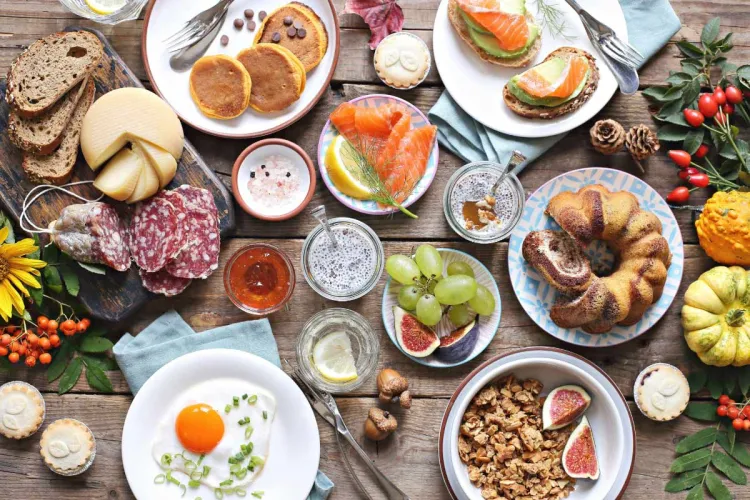
It arrives late enough in the morning that no one has to rush, early enough that the afternoon is still ahead, and at exactly the right moment for a glass of something sparkling. It is the meal where sweet and savoury share the table without argument, where the newspaper is acceptable company, and where the question of whether to have another coffee or switch to something cold is entirely reasonable.
The word itself is almost 130 years old. The British journalist Guy Beringer coined it in 1895, proposing a Sunday meal that would spare Saturday-night revellers the ordeal of an early breakfast and allow them to recover in peace. The idea crossed the Atlantic, took hold in American cities during the 1930s, and by the 1980s had become a fully-fledged New York social institution — bottomless Mimosas, hour-long queues, and a particular kind of weekend urgency that has since spread to cities worldwide. Today brunch belongs to everyone, and every food culture has found its own way of doing it.
Brunch around the world
The American brunch is the template most people know: a diner table, eggs in several forms, pancakes arriving at one end of the table while bacon arrives at the other, and a pitcher of orange juice that may or may not have sparkling wine in it. It is generous, unhurried, and deliberately indulgent — a meal that announces, clearly, that today is not a workday. American breakfast and brunch culture has its own strong regional identities: biscuits and gravy in the South, bagels and lox in the Northeast, avocado toast on the West Coast.
The British and Irish version runs parallel but differently. The full cooked breakfast — eggs, bacon, sausages, toast, and in Ireland black and white pudding — has evolved into a brunch culture that now includes eggs Royale, smashed avocado on sourdough, and the flat white. The gastropub brunch, in particular, has become one of the more civilised ways to spend a Sunday morning in Britain.
Australia has arguably developed the most serious café brunch culture in the world. The flat white was invented there, the sourdough movement took hold early, and Australian cafés set a standard for egg dishes and brunch menus that has influenced cities from London to Los Angeles. Brunch in Sydney or Melbourne is not a casual afterthought — it is a considered meal served with care.
In Israel and across the Middle East, brunch takes on a completely different character: a spread of small dishes rather than a single plate, with shakshuka (eggs poached in a spiced tomato sauce), labne, hummus, olives, fresh salads, and warm flatbread covering the table. It is communal by nature and substantial by design. In France, le brunch has arrived in Paris in recent decades, typically involving tartines, croissants, poached eggs, and a glass of something cold. And in Japan, the kissaten (coffee shop) morning set — toast, a soft-boiled egg, a small salad, and coffee — is its own quietly perfect version of the same idea.
What to eat
The brunch table works best when it balances sweet and savoury, light and substantial, things that can be made ahead and things cooked to order. A few categories cover most of what you need.
Eggs are the centre of gravity. Scrambled, poached, baked, or set into a casserole or strata — they suit brunch because they cook quickly, pair well with almost everything else on the table, and carry flavour easily. Scrambled eggs with asparagus, crab, and chives is an elegant option when you want something beyond the everyday. Bacon and egg casserole and ham and cheese strata both work for a larger group and can be started the night before — the strata in particular benefits from an overnight rest in the refrigerator.
Breads and pastries give the table its backbone. Swiss braided butter bread is one of the great brunch breads: soft, golden, and made for tearing and sharing. Bagels are the New York answer — best with cream cheese, smoked salmon, and thin-sliced red onion. Cheese bread and blueberry and oat bran muffins fill out the sweeter end.
Pancakes and oven dishes suit a brunch where people want something more substantial. Dutch babies — oven-baked pancakes, puffed and golden, from German tradition — are spectacular to bring to the table and surprisingly simple to make. Zucchini and cheese pancakes cover the savoury side. Leek and cheese pie is the sort of thing that makes people quietly pleased they came.
Seafood and cured fish bring a touch of occasion to the table with almost no effort. Gravlax — Scandinavian salt-and-dill cured salmon — can be made two or three days ahead and sliced at the table. Crab cocktail is light, colourful, and serves as a fine starter if you are doing a more structured brunch.
Cold dishes and salads round out a buffet-style spread and are entirely make-ahead. Southern deviled eggs, serrano and melon jelly, and a simple potato salad all keep well and need no attention on the day itself.
What to drink
Brunch is one of the few meals where sparkling wine in the morning is not only acceptable but actively encouraged. The Mimosa — equal parts sparkling wine and fresh orange juice — is the classic, simple enough to make in a pitcher for a group. The Bellini (Prosecco and white peach purée) is the more elegant Italian version. A Kir Royale — crème de cassis and Champagne — suits a more formal occasion. For the full range of sparkling brunch cocktails, see the wine cocktails guide.
Coffee is the other non-negotiable. A good espresso machine earns its place at a brunch table. For something more considered, the Viennese Einspänner — a double espresso under a cloud of softly whipped cream, sipped through rather than stirred — is one of the more civilised ways to start a late morning. The Korean iced Einspänner is its summer equivalent.
Fresh juice, sparkling water with citrus, and good tea cover the non-alcoholic side. The important thing is to have both cold and hot options — a brunch table without something to offer both the early arrivals and the ones who come in an hour later does not quite work.
How to host a brunch
A brunch is one of the easier meals to host well, provided you make the right things ahead of time. The instinct to cook everything fresh is understandable but unnecessary — most of what makes a brunch table good is made the night before.
The night before: make the strata or casserole (both are better for overnight resting), cure the gravlax if you are serving it, prepare the deviled eggs, make any salads that benefit from resting, and mix the Bloody Mary base without the alcohol. If you are making Swiss braided bread or bagels, this is also when the dough gets made.
On the morning: bake anything that needs to go in the oven, brew the coffee, chill the sparkling wine, and slice the gravlax. Eggs, if you are doing them to order, are the last thing you cook — everything else should be on the table before the first guest arrives.
Timing: aim for 11am. It is early enough that people have the afternoon ahead, late enough that no one needs to rush. A two-hour window is natural — people arrive at different times, eat at their own pace, and the table can hold everything without food sitting too long.
Buffet or plated: for more than four people, a buffet is almost always the better choice. It allows people to graze at their own pace, removes the pressure of timed service, and means everything can be made ahead. For a smaller group where you want to cook eggs or Dutch babies to order, plating works well — but keep it simple. Two or three components, done properly, are better than six half-finished ones.
Brunch recipes
The full collection of brunch recipes at World Food and Wine covers eggs, breads, salads, seafood, pastries, and cold dishes from a wide range of cuisines. Browse the complete list.