Nestled in the lush, rolling hills of Northeast India lies Assam, a state famed for its sprawling tea gardens, the mighty Brahmaputra river, and a cultural heartbeat that thumps to the rhythm of the dhol (drum). If you visit Assam, you aren't just a tourist; you are a guest in a land where agriculture is life and community is everything. At the center of this vibrant tapestry is Bihu—not just a festival, but the soul of the Assamese people.
Bihu isn't a single event marked on a calendar; it is a set of three distinct festivals that mirror the cycle of farming life. It celebrates the changing seasons, the preparation of the fields, and the joy of the harvest. For foodies and culture seekers, experiencing Bihu is like stepping into a living, breathing celebration of gratitude and abundance. Whether you are looking to expand your culinary horizons or find your next travel destination, understanding Bihu offers a fascinating glimpse into a culture that deeply honors the land.
The three faces of Bihu
While the world often sees festivals as singular dates, the Assamese people celebrate the rhythm of nature through three unique Bihu festivals. Each corresponds to a different phase of the agricultural cycle and brings its own mood, rituals, and flavors.
Rongali Bihu (Bohag Bihu) is the festival of joy
celebrated in mid-April, Rongali Bihu is the headliner—the most popular and colorful of the three. Marking the Assamese New Year and the arrival of spring, Rongali comes from the word rong, meaning color and joy.
This festival kicks off the sowing season. The fields are being prepped, the orchids are blooming, and the air is filled with anticipation. The celebration spans seven days, known as Xaat Bihu, with specific days dedicated to different aspects of life:
- Goru Bihu: The first day is dedicated to cattle. Cows are bathed with a paste of black gram and raw turmeric, fed vegetables, and thanked for their help in the fields.
- Manuh Bihu: The second day focuses on human relationships. People wear new clothes, seek blessings from elders, and exchange Gamosas—a traditional red-and-white handwoven cloth that is a symbol of respect and love.
- Music and Dance: You cannot speak of Rongali Bihu without the Husori. Groups of musicians move from house to house, singing traditional songs and performing the Bihu dance—a courtship dance characterized by rapid hand movements and energetic steps.
Kongali Bihu (Kati Bihu) is the solemn prayer
Fast forward to mid-October, and the mood shifts. Kongali Bihu, also known as Kati Bihu, is less about feasting and more about reflection and protection. The name Kongali translates to "poor," reflecting a time when the granaries are empty and the rice paddies are still maturing.
There is no grand merriment here. Instead, there is a quiet, spiritual beauty.
- Lighting the Way: The defining visual of this festival is the Saki (earthen lamp). Families light lamps at the foot of the sacred Tulsi plant (holy basil) in the courtyard, praying for a bountiful crop.
- Akash Banti: Farmers light special sky lamps on tall bamboo poles in the paddy fields. Culturally, these are believed to guide ancestors' souls, but practically, they help ward off pests that could damage the growing crops.
Bhogali Bihu (Magh Bihu) is the feast of abundance
Come mid-January, the harvest is over, and the granaries are full. It is time for Bhogali Bihu, derived from the word Bhog, meaning eating and enjoyment. This is the food lover’s Bihu!
This festival is akin to Thanksgiving, but with a community-wide bonfire.
- Uruka (Community Feast): On the eve of the festival, men build temporary shelters called Bhelaghar and towering bonfires called Meji from bamboo and thatch. The community gathers here for a massive feast, cooking fresh harvest produce and fish.
- The Morning Fire: At dawn the next day, the Meji is burned as an offering to Agni, the fire god. People gather around the warmth, cracking coconuts and praying for prosperity in the coming year.
The taste of tradition: Bihu on a plate
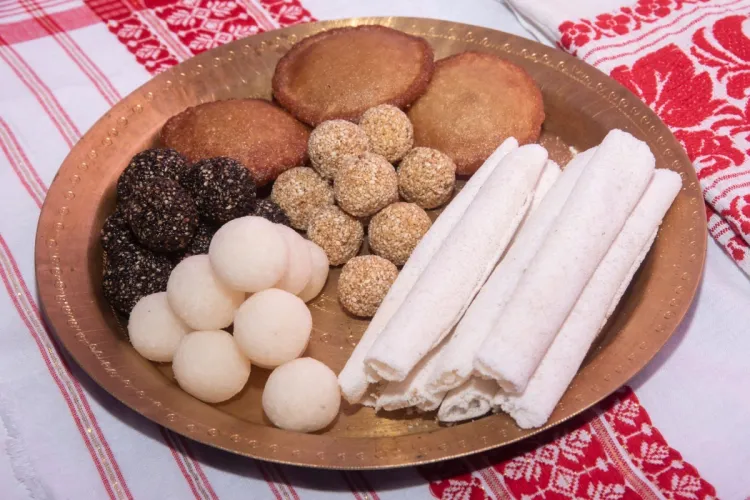
For a culinary explorer, Bhogali Bihu is the ultimate experience. Assamese cuisine during this time is characterized by rice, coconut, jaggery, and sesame. It is simple, earthy, and incredibly comforting. Here are the staples you must know:
Jolpan: The breakfast of champions
In Assam, you don't just have breakfast; you have Jolpan. This is a collection of traditional snacks served with curd (yogurt) and jaggery. It often includes:
- Bora Saul: Sticky rice that is boiled and eaten with milk or yogurt.
- Chira: Flattened rice that requires no cooking—just soaking.
- Kumol Saul: A unique variety of "soft rice" that can be eaten after just soaking in warm water for a few minutes.
Pitha: The sweet soul of Bihu
No Bihu is complete without Pitha. These are rice cakes made in various ways, steamed, fried, or baked.
- Til pitha: The most iconic variety. Til pitha (sesame rice roll) is a cylindrical roll made of sticky rice flour filled with a mixture of roasted black sesame seeds and melted jaggery. It’s crunchy, chewy, and sweet all at once.
- Ghila pitha: Deep-fried rice flour fritters sweetened with jaggery. These ghila pitha can also be made with dark brown sugar.
- Sunga pitha: Rice cooked inside fresh bamboo hollows, giving it a distinct, grassy aroma.
Laru: Sweet Spheres
These are sweet balls made from different ingredients mixed with melted jaggery. Narikol laru (coconut balls) and til laru (sesame balls) are essential treats found in every Assamese home during the festival.
Why Bihu matters today
In an era of fast fashion and fast food, Bihu stands as a testament to sustainability and community. It reminds us that our food has a source and that the seasons dictate our survival.
For the modern traveler or culture enthusiast, Bihu offers a connection to roots. It is not just about the Instagram-worthy dance moves or the delicious Pithas; it is about witnessing a society that still pauses to thank the cows, light a lamp for the crops, and share a meal with the whole village.
If you ever find yourself in Northeast India, try to time your visit with one of these festivals. Eat the sticky rice, watch the fire of the Meji rise into the winter sky, and dance to the beat of the dhol. You will leave with a full belly and an even fuller heart.
Due to the proximity and the presence of Assamese populations, you will also see Bihu celebrated in parts of:
- Arunachal Pradesh
- Meghalaya (especially in Shillong)
- Nagaland (Dimapur regions)
In the United Kingdom, the London Bihu Committee typically organizes a large gathering for Rongali Bihu (in April) and Bhogali Bihu (in January) with traditional food and dance.
USA, Canada, Australia: Major cities with Indian diasporas often have local Assamese associations that host Bihu lunches or dinners.
While "Bihu" is specific to Assam, it coincides with harvest festivals across India celebrated on the same days under different names:
- Makar Sankranti (North India)
- Pongal (Tamil Nadu)
- Lohri (Punjab - usually a day prior)
- Poush Sankranti (West Bengal)