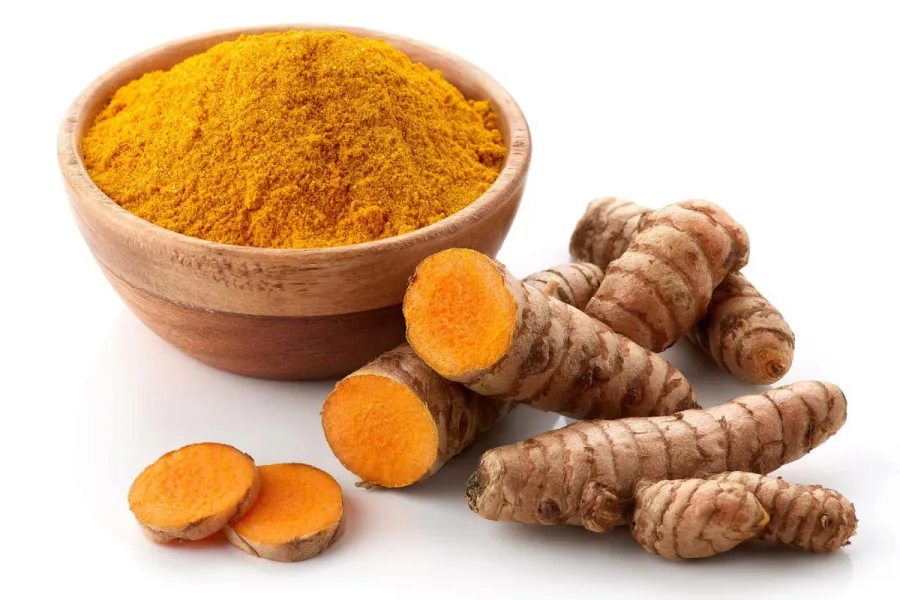
It is used as a seasoning and coloring agent mainly in Middle Eastern and Indian cooking, added to rice, meat and fish dishes, sauces and vegetables, many curry mixes, pickles and chutneys. It also gives the yellow color to some kinds of mustard.
Turmeric is one of the great Indian spices and one of the most affordable, since it thrives in the tropical regions where it is grown. In recent years it has become a global pantry staple, driven by growing interest in its distinctive flavor and remarkable health properties.
Facts
Turmeric has been in use for at least 4,000 years, not only as a spice but as a perfume, a dye for priestly and Buddhist monks’ robes, and a cornerstone of Ayurvedic medicine. It traveled the Silk Road from India to the Arab world and into medieval Europe, where it was known as Indian saffron and used mainly as a cheaper alternative for color. Marco Polo noted it during his travels in the 13th century, comparing it to saffron though recognizing it as a different plant entirely.
As a paste, turmeric is still used in traditional medicine to relieve itching, rashes and skin conditions. In South Asian wedding traditions, a turmeric paste called haldi is applied to the skin of both bride and groom before the ceremony — for purification, beauty, and good luck.
The word turmeric likely derives from the Latin terra merita, meaning “meritorious earth” — probably because the bright yellow powder resembles a richly colored mineral earth.
Curcumin and the black pepper connection
Curcumin is the active compound that gives turmeric its vivid color and is responsible for most of its documented health properties, including anti-inflammatory and antioxidant effects. However, curcumin is poorly absorbed by the body on its own. Combining turmeric with black pepper dramatically increases absorption — piperine, the active compound in black pepper, can enhance curcumin uptake by up to 2,000 percent according to some studies. This is not a modern discovery; the two spices have been paired together in Indian cooking and Ayurvedic practice for centuries.
How to identify turmeric
Turmeric comes from the knobbly rhizome or root of a ginger-like plant. The rhizome has a yellow-brown rind and a vivid orange interior. Dried and ground, it becomes the familiar bright yellow powder found in most spice racks. Its flavor is earthy, warm, and mildly bitter — sweeter and more delicate than ginger, but with a distinctive slight astringency.
Fresh turmeric root
Fresh turmeric root is increasingly available in supermarkets and Asian grocery stores, and is worth seeking out. It looks like a smaller, more intensely colored cousin of fresh ginger, with a thin brown skin and deep orange flesh. Use it grated or finely sliced in curries, soups, dressings, juices, and smoothies. The flavor is brighter and more complex than the dried powder. Peel it as you would ginger, and be aware that it stains (see below).
As a rough guide, substitute 1 teaspoon of dried turmeric with about 1 tablespoon of freshly grated turmeric root.
The plant
The plant is a tropical perennial that can grow up to 3 ft (1 m) high. It has long, lily-like leaves and produces spikes of yellow-green flowers in summer. It is native to South Asia — India is both its probable origin and by far the world’s largest producer and consumer today. It is also grown throughout Southeast Asia, China, Indonesia, Australia, and in tropical parts of Africa and the Americas, including Jamaica and Peru.
How to use and store
The spice is produced from the roots of the plant. The rhizome is boiled, dried, and ground to a fine yellow powder before use. Dried pieces of root can occasionally be found, but they are almost impossible to grind at home.
Turmeric is usually available as powder. Buy little and often for the freshest, purest flavor — as recommended with all ground spices. Although the powder keeps its coloring properties indefinitely, it loses flavor over time and can turn musty if kept too long. Store in a sealed jar, away from light and heat.
Turmeric is mainly used in curries and other spiced dishes. It is an essential ingredient in commercial curry powders. It can be found as a natural coloring in prepared chicken or vegetable stock and stock cubes too. Turmeric can be used in pickles and chutneys, in picalilly relish; turmeric gives flavor to pilaus and color to sweet dishes.
In North African and Middle Eastern cuisine, tumeric is added to sauces, couscous and rice dishes.
A word about staining
Turmeric stains intensely and almost permanently. It will color cutting boards, wooden spoons, plastic containers, light-colored countertops, clothes, and hands a deep yellow that is very difficult to remove. When working with turmeric — especially fresh root — wear an apron and use equipment you don’t mind discoloring. Rinsing immediately with cold water and sunlight exposure can help fade stains on fabric; hot water tends to set them.
Cooking with turmeric
In India, the spice mix for a curry is prepared fresh, often enough for a week — curry powder as a pre-mixed product is largely a convenience of export. Preparing your own blend, with turmeric as a foundation, gives you far more control over flavor and freshness.
Turmeric is an essential ingredient in commercial curry powders and widely used in North African and Middle Eastern cuisine, added to couscous, rice dishes, and slow-cooked sauces. It provides natural color to prepared stocks and stock cubes, and is the spice behind piccalilli relish.
It pairs naturally with ginger, cumin, coriander, cardamom, coconut milk, lentils, cauliflower, eggs, and rice. The combination with black pepper is worth making a habit — add a pinch whenever you use turmeric for both flavor and the absorption benefit described above.
Turmeric is sometimes used instead of saffron as a color substitute. It gives a similar yellow hue, but the flavors are quite different. A better approach is to use a small pinch of turmeric alongside a reduced amount of saffron — you keep the saffron character while stretching it further.
Turmeric also works well in smoothies with mango, pineapple, or banana; in salad dressings; and stirred into scrambled eggs or rice during cooking for color and a gentle earthy note.
Yellow chicken
The sauce sets to a lovely lemon colored jelly when cold.
Ingredients
2 tbsp olive oil
1 clove garlic, minced
juice of 1 lemon
1/2tsp turmeric
1 cardamom pod cracked or 1/2tsp cardamom seeds
1/3 cup (10 tbsp) water or chicken stock
1 lb chicken breast, skinless and cut into pieces
salt and pepper to taste
parsley to garnish
Instructions
Heat the oil in a pan and brown the chicken pieces for 3-4 minutes.
Add the garlic, lemon juice, cardamom, stock, and seasoning.
Bring it slowly to a boil, cover and cook gently for 15-20 minutes.
Turn the pieces often and add a little water if necessary.
When cooked, transfer to a warmed serving dish, cover with the sauce and sprinkle with chopped parsley.
Notes
Try using other chicken parts, skin and bone in for a richer jelly, coriander instead of parsley, try this recipe with a firm white fish like monkfish. Do not forget to adjust the water added and cooking time accordingly.