
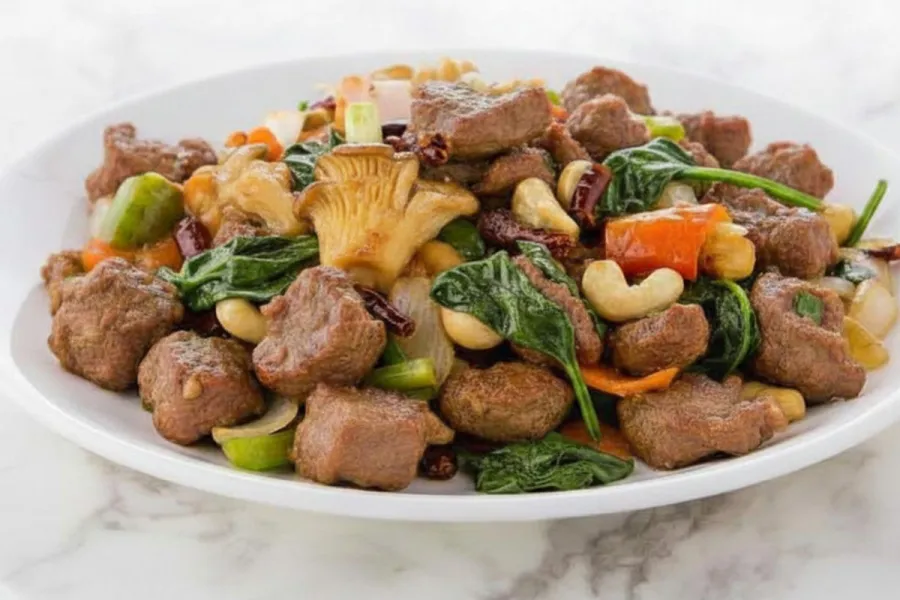
A good stir-fry is one of the fastest routes to a satisfying dinner, and this one rewards you in about half an hour. Strips of tender lamb are seared in a hot wok, then folded through sweet red pepper, oyster mushrooms, and a generous tumble of spinach in a glossy oyster-sauce glaze. Roasted cashews add crunch, and fresh basil lifts the whole dish with a fragrant, faintly aniseed note. It isn't tied to any one country, it borrows the wok and the sauce from China, the basil from Southeast Asia, and a love of lamb from cooks who reach for it the way others reach for beef.
Ingredients
Instructions
In a small bowl, stir together the oyster sauce, soy sauce, garlic, ginger, and brown sugar. In a separate bowl, blend the cornstarch with the cold water into a smooth slurry. Set both aside.
Heat half the oil in a wok over high heat until shimmering. Stir-fry the lamb in two or three batches, just until browned and almost cooked through, about 1 to 2 minutes per batch. Transfer to a plate. Crowding the wok steams the meat instead of searing it, so give each batch room.
Add the remaining oil to the wok. Stir-fry the red pepper and mushrooms until just tender, 2 to 3 minutes.
Return the lamb and any resting juices to the wok. Add the spinach and the sauce mixture and toss until the spinach begins to wilt. Pour in the cornstarch slurry and stir-fry until the sauce boils and thickens to a glaze, about 1 minute.
Serve straight away over steamed rice, scattered with the basil and cashews.
Background and history
You'll find lamb and cashew stir-fries on plenty of menus and in plenty of home kitchens, but the dish doesn't belong to a single national cuisine. It's better understood as a meeting point of several Asian cooking traditions, brought together in the wok.
The method itself is Chinese. Stir-frying — cooking small pieces of food quickly over fierce heat while keeping them moving — was refined over centuries in China and is the technique every wok dish is built on. The cashews point to southern China in particular: cashew chicken is a Cantonese classic that travelled the world through Chinese restaurants, and Thailand later made the idea its own with gai pad med mamuang, chicken stir-fried with cashews.
The lamb tells a different part of the story. In southern Chinese cooking, pork and chicken dominate, but in the north — and especially in the cooking of the Hui Muslim communities and the Uyghur kitchens of Xinjiang — lamb is the everyday meat. Dishes like Beijing-style scallion lamb and the cumin-scented lamb of the northwest show how at home it is in a hot wok.
The fresh basil, finally, is a Southeast Asian flourish; Thai cooks in particular love the way its perfume cuts through a rich, savory sauce. Put all of that together — Chinese technique, Cantonese cashews, northern lamb, Southeast Asian herbs — and you get a thoroughly modern dish, one that became a weeknight favorite in countries like Australia, where lamb is the meat cooks reach for first and the wok long ago earned its place on the stove. It's a small culinary passport in a single pan.
Notes
For tender, restaurant-style lamb, "velvet" it first: toss the sliced lamb with 1 teaspoon soy sauce, 1 teaspoon cornstarch, and 1 teaspoon oil, and let it sit while you prep everything else.
Slice the lamb thinly across the grain. It's far easier if you firm the meat up in the freezer for 15 to 20 minutes first.
Have everything cut, measured, and within arm's reach before you turn on the heat. Stir-frying moves fast, with no time to chop once the wok is hot.
Get the wok as hot as you dare before the lamb goes in — that quick, high sear is what gives a stir-fry its flavor.
Add the cashews right at the end so they stay crisp. A short toast in a dry pan first deepens their flavor.
A splash of Shaoxing wine (or dry sherry) added with the sauce brings a little extra depth.
To drink: this dish likes a soft, fruit-forward red such as a Grenache or a lighter Shiraz. If you add chili, an off-dry Riesling stands up nicely to the sweet-savory glaze.
Variations
Swap the protein: thinly sliced beef sirloin, chicken thigh, or pressed firm tofu all work in place of lamb.
Go Southeast Asian: use Thai or holy basil and add a sliced red chili or two for something closer to a Thai stir-fry.
Go northern Chinese: trade the basil for a teaspoon of toasted ground cumin and a pinch of dried chili flakes, echoing the cumin-lamb cooking of Xinjiang.
Change the vegetables: snow peas, broccolini, baby corn, or sliced scallions are all good alongside the lamb.
For a sweeter, deeper sauce, replace a tablespoon of the oyster sauce with hoisin.
To keep it gluten-free, use tamari and a gluten-free oyster sauce.
Source
Food in Asia