Oktoberfest beer explained
Märzen, Festbier and the six breweries
Sometime in late August, a particular kind of beer appears on American shelves. It's amber, faintly reddish, malty and soft, and the label says Oktoberfest. It's one of the reliable pleasures of the season, and most people who buy it assume it's a copy of what's poured in Munich.
It isn't, quite. The beer in the tents on the Theresienwiese is mostly paler than that, closer to gold than amber. Both versions have a fair claim to the name, and the gap between them is a genuinely interesting piece of history: the style that crossed the Atlantic stayed put, while the one at home kept moving.
Here's how that happened, and what to do about it in September.
What makes a beer Oktoberfest beer
In Munich, the definition is strict. Only six breweries may pour at the festival — Augustiner, Hacker-Pschorr, Hofbräu, Löwenbräu, Paulaner and Spaten — and the beer must be brewed within the city limits. That rule has held for well over a century, and it's the reason festival beer is a real category rather than a seasonal label.
The beer they make for it is called Wiesnbier, after the Wiesn, the meadow the festival is held on. It's produced specifically for those sixteen days, sold only during them, and it's stronger than everyday Bavarian lager at somewhere around 6 percent alcohol. That matters more than it sounds, for reasons we'll get to when we talk about the serving size.
In the United States, none of this applies. "Oktoberfest" isn't protected here, so any brewery in any state can put it on a can. That's not a scandal — plenty of American Oktoberfest lagers are excellent — but it does mean the word tells you about a style rather than an origin.
Märzen and the problem of summer
To understand the amber beer, you have to go back to a practical problem: for most of brewing history, summer was the enemy.
Warm weather made fermentation unpredictable and spoilage likely, and Bavaria eventually dealt with this by regulation, restricting brewing to the cooler months of the year. So brewers made their last batch in March — März — and made it deliberately stronger and more heavily malted so it would survive storage. It went into cool cellars and ice caves and sat there through the summer. What was left by autumn got drunk down before the new brewing season began.
That's Märzen. The higher alcohol and the rich, bready malt character weren't stylistic choices at first. They were preservation, and they happened to taste good.
The constraint disappeared in the nineteenth century, when refrigeration and a much better understanding of yeast made year-round brewing possible. Munich's brewers were central to that work — Spaten in particular was one of the great technical innovators of the period, a story we tell in more detail in our history of beermaking. But by then Märzen had stopped being a necessity and become a tradition, and it attached itself to the autumn festival that was already happening.
How Munich's beer turned gold
Over the course of the twentieth century, the beer poured at Oktoberfest drifted lighter. The amber Märzen gave way gradually to a paler, cleaner, more golden beer, still strong but less heavy on the palate. Today most of what's served in the tents is this newer style, usually called Festbier.
The reasoning is not mysterious once you've seen the glassware. When someone is going to drink a liter of beer over an hour or two, in a warm tent, in the afternoon, a lighter lager is simply easier to get through. Festbier keeps the strength and loses some of the weight.
Meanwhile, the amber Märzen that had been exported to America — and brewed by German immigrant brewers there since the nineteenth century — stayed roughly where it was. The result is a small historical irony: the Oktoberfest beer in a US supermarket is often closer to what Munich drank in 1900 than what Munich drinks now.
The styles, sorted out
Five names come up around Oktoberfest, and they're worth separating.
Märzen is the amber one. Copper to light brown, malty, with flavours in the range of toast, bread crust and light caramel, and a dry finish rather than a sweet one. Around 5.5 to 6 percent. This is the style most American Oktoberfest beers are built on.
Festbier is the modern Munich festival beer. Gold, clear, cleaner and crisper than Märzen, with the malt present but lighter — think fresh bread rather than toast. Similar strength, around 6 percent. Brewed to be drunk in quantity.
Helles is Munich's everyday pale lager, and the everyday counterpart to Festbier. Gentle, soft, lightly bready, around 5 percent. If you want to understand Bavarian brewing, this is the beer to start with, because there is nowhere to hide in it.
Dunkel is the dark Munich lager, and older than Helles. Deep brown, with chocolate and dark bread flavours, but much lighter-bodied than the colour suggests. Usually around 5 percent. Not a festival beer as such, but you'll find it in the city.
Weissbier is the Bavarian wheat beer: hazy, foamy, with distinctive banana and clove flavours that come from the yeast rather than any additive. Around 5.4 percent. It's worth knowing because it's the beer served in the festival's wine tent until nine in the evening, which is one of the odder facts about the Wiesn.
The Maß, and what a liter does to a beer
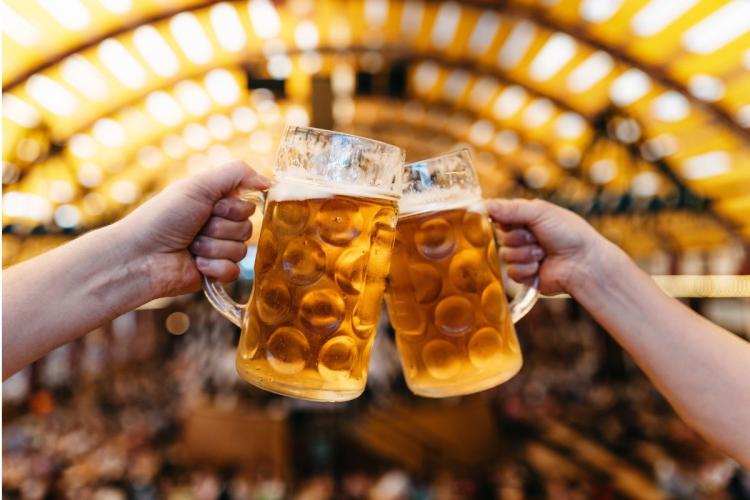
Festival beer is sold in one size only: the Maß, a one-liter glass or ceramic stein. That's 33.8 fluid ounces, or just over two US pints, in a single vessel.
This is not a detail. It shapes the beer itself. A Maß takes a long time to drink, and it warms steadily while you do, so a festival beer has to still taste right when it's no longer cold. That rules out anything too aggressive, too hoppy or too sweet, and it pushes brewers toward balance and drinkability. The serving size is as much a design constraint as any brewing tradition.
It's also worth being straightforward about the arithmetic. A liter at 6 percent is roughly three and a half standard US drinks. One Maß is not one beer, and the tents are warm.
The other thing the Maß produces is a genuine professional skill. Servers carry eight, ten, sometimes more at a time, fully loaded, through a crowd. A full Maß weighs close to five pounds with the glass. Watching it done well is part of the experience.
Buying and drinking it in the United States
Actual Wiesnbier is difficult to find here. The six breweries do export seasonal beers, and Paulaner, Hofbräu, Spaten and Hacker-Pschorr all turn up in well-stocked US stores in the autumn, though what's in the bottle may not be identical to what's in the tent.
Everything else on the shelf is an American interpretation, and most of those are amber Märzen-style. That's the tradition US brewers inherited, and many of them do it very well. Look for it from late August through early October — it's a genuinely seasonal release, and when the displays come down, it's gone until next year.
Serve it cool rather than cold. Straight from a US refrigerator is too cold for a beer built on malt flavour; twenty minutes on the counter will open it up considerably. Use the largest glass you own. And if you find both an import and a domestic Märzen, buy one of each and taste them side by side — the difference between gold and amber is the whole story of this page in two glasses.
What to drink it with
Festival beer is built for rich, salty, fatty food, which is exactly what the festival serves: roast chicken, pork, pretzels, and cheese. Märzen's malt sweetness in particular is very good against crisp roasted skin and against smoked or cured meat.
For the full picture of what's eaten alongside it, start with our guide to Oktoberfest food and drink, and for the wider context of where these beers sit in German brewing, see beer in Germany.