
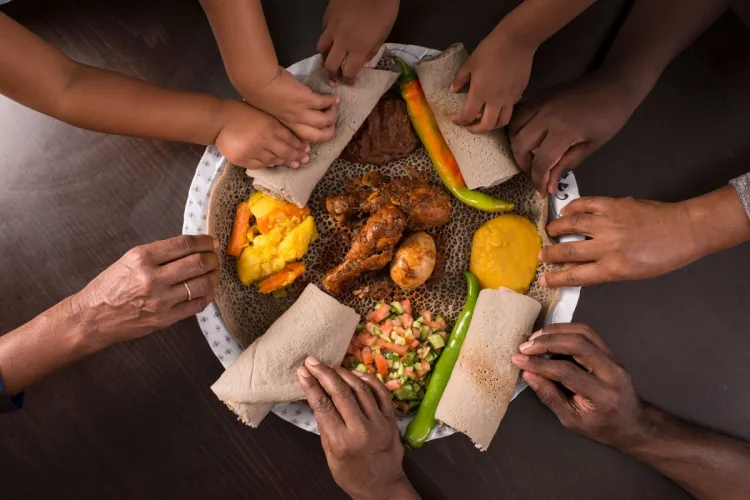
Ethiopian food is served on a single wide platter, lined with a soft, sour flatbread, with the stews spooned straight onto it in bright heaps. There are no plates and no cutlery. Everyone tears at the bread, wraps it round whatever they want, and eats with their hands from the same surface. It is one of the most sociable ways of eating anywhere in the world, and it is the first thing to understand about the cuisine, because almost everything else follows from it.
What follows is a guide to how Ethiopians actually eat: the bread, the two great families of stew, the fasting calendar that produced one of the world's richest vegan repertoires, the raw meat traditions, the other staple that isn't teff at all, and the coffee that Ethiopia gave the rest of us.
The food and the country behind
Ethiopia sits in the horn of Africa, bordered by Eritrea, Djibouti, Somalia, Kenya, South Sudan and Sudan. It is large — roughly twice the size of France — and its landscape swings violently between extremes. The Great Rift Valley cuts across it from south-west to north-east. The Danakil Depression lies below sea level and is among the hottest inhabited places on earth, while two thirds of the country sits on plateaus between four and ten thousand feet, where the climate is mild and the rain arrives in summer.
That range decides what grows where, and the cuisine follows the geography closely. Highland cooking is not lowland cooking, and the food of the south is not the food of the north.
The population is equally varied: something like eighty ethnic groups, more than a hundred languages and dialects, and a population divided mainly between Ethiopian Orthodox Christians and Muslims. Amharic is the common language, written in its own script inherited from Ge'ez.
One historical fact shapes the food more than any other. Apart from the Italian occupation that began in 1935 and lasted a few years, Ethiopia was never colonised. Its cuisine absorbed what it wanted from trade with Arabia, India and the Mediterranean, and kept its own shape. The result is a cuisine that tastes like nowhere else.
Injera, and the grain it's made from
Injera is the foundation. It is a large, soft, spongy flatbread with a distinctly sour taste, and it works as plate, utensil and food all at once.
It's made from teff, a cereal domesticated in the Ethiopian highlands thousands of years ago and grown almost nowhere else until recently. The grains are extraordinarily small — thousands of them fit in a single gram — yet dense in iron, calcium, fibre and protein. Teff is Ethiopia's most widely farmed crop and supplies a substantial share of the country's calories. It comes in ivory, brown and red varieties; the ivory is considered the finest and mildest, while the darker types make the everyday injera. Ethiopia restricts export of the whole grain, allowing the flour out instead, which is why teff flour is easier to buy abroad than teff itself.
The step that makes injera what it is happens before any heat is involved. The batter is fermented, traditionally for about three days with a sour starter, and that fermentation produces the tang. Along the way many cooks use a technique called absit — boiling a portion of the batter and stirring it back in hot — which speeds the process along.
Baking happens on a mitad, a wide flat griddle of clay or metal with a domed lid, and the batter is poured in a spiral from the outside in. As it cooks, bubbles break across the surface and leave small holes called ayen — "eyes." These are how injera is judged. The more even and plentiful the eyes, the more sauce the bread holds, and mixing and pouring a batter that produces them consistently takes cooks years to master.
At the table, guests wash their hands first, break off pieces with the right hand, and use them to pinch up the stews. A bite that gathers several stews together is a goursha, and feeding one to someone else is a gesture of warmth.
Injera made purely from teff is vegan and gluten-free. Be careful with that claim in practice, though: a great deal of commercial and restaurant injera is blended with barley, wheat or sorghum, so anyone avoiding gluten needs to ask rather than assume.
Wat and alicha: the two families of stew
Nearly every Ethiopian stew belongs to one of two families, and the colour tells you which.
Wat is the red one, built on berbere, the chilli-based spice blend that gives Ethiopian cooking its signature. Deep red, warm, aromatic, and hot without being punishing.
Alicha is the golden one, built on turmeric, with no chilli at all. Mild, gentle and fragrant, it exists precisely as the counterweight to wat, and a good platter carries both.
Both begin the same way, with a base called kulet: finely chopped red onion, garlic and ginger cooked slowly into something sweet and dense. The technique is distinctive enough to be worth knowing even if you never cook it — the onions go into a dry pan with no oil at all and are cooked down until soft and almost dry, and only then do the garlic, ginger and oil join them. Outside fasting periods a spoonful of niter kebbeh, the spiced clarified butter, goes in too.
The most celebrated dish in the country is doro wat, a slow chicken stew heavy with berbere and niter kebbeh, served with hard-boiled eggs sitting in the sauce. It is the dish of holidays, weddings and important guests, and it occupies roughly the position turkey does in an American Thanksgiving. Convention is to enjoy the sauce and the eggs first and come to the chicken last.
Fasting, and why the vegetarian food is so good
Ethiopia has one of the world's great vegan repertoires, and it did not arrive through fashion.
For observant Ethiopian Orthodox Christians, fasting means no animal products at all — no meat, no dairy, no eggs — and the obligation covers something close to half the year, every year. Wednesdays and Fridays, plus the long fasts around Lent and other seasons. Islam, followed by roughly a third of the country, brings its own fasting periods.
Centuries of that produced a body of vegetable and pulse cooking that isn't a substitute for anything. These are simply what half the year tastes like.
Shiro wat — a thick, smooth stew made from milled chickpeas or broad beans blended with spices, cooked with onion, garlic and berbere. The most everyday dish in the country and, for many Ethiopians, the taste of home.
Misir wat — red lentils, onion, garlic and berbere. Rich, deep red and filling.
Gomen — collard greens or kale, cooked down with onion, garlic and often ginger.
Atakilt — cabbage, carrot and potato with turmeric. An alicha, gentle and golden, and one of the dishes that balances the platter.
Fasolia — green beans and carrots with onion and tomato.
Azifa — a cold green lentil salad sharpened with lemon and Ethiopian mustard. Refreshing against everything else.
Timatim — a chopped tomato and onion salad with green chilli, olive oil and lemon.
Outside fasting, ayib joins them: a mild fresh cheese, loose and crumbly, something like a lightly acidic ricotta. Its job is cooling, and a spoonful next to a fierce red stew does more than any drink would.
Meat, tibs and the raw meat tradition
Ethiopia has one of Africa's largest livestock populations, and beef dominates — mostly from the humped zebu, introduced from India by way of Somalia thousands of years ago. Lamb, goat and chicken are all widely eaten. Pork essentially isn't, on both Orthodox and Muslim grounds.
Meat is usually cut small rather than served as large joints. Tibs are bite-sized pieces seared fast over high heat and brought to the table still sizzling, often in an earthenware dish; zilzil tibs uses long strips instead, and is frequently finished with awaze, the berbere dipping sauce.
Kitfo is minced beef, warmed gently or left raw, dressed with mitmita and niter kebbeh. It is the signature dish of the Guragé people and is usually served with ayib and with kocho, the bread made from enset.
Then there is kurt — the all-meat platter, and a genuine institution. The word means "a cut." Raw beef is aged for a day or two, displayed in specialist restaurants known as kurt bet or lookanda bet, carved to order and brought out in quantity with awaze, Ethiopian mustard and injera. Almost every part of the animal can be served this way, and connoisseurs ask for particular cuts by name, including the hump and the first rib. Thursdays, Saturdays and Sundays are the traditional days, and in some parts of the country kurt is eaten at breakfast.
It is, for visitors, the most startling thing on the Ethiopian table. It is also completely ordinary there, and taken seriously — the quality of the beef and the length of the ageing are what people discuss.
Enset, the other staple
Teff and injera dominate any account of Ethiopian food, including this one. But in the south and west of the country, the staple is something else entirely.
Enset looks like a banana tree and bears no useful fruit, which is why it's called the false banana. What it offers instead is starch, stored in its root and stems. It has been cultivated in Ethiopia for thousands of years and it forms the backbone of the diet for something like a fifth of the population.
Its great virtue is stubbornness. Enset is known as the tree against hunger because it withstands drought for years on end and can be harvested whenever it's needed rather than at a fixed season — a genuine insurance policy in a country that has known famine.
The starch is scraped from the root and stems, wrapped, buried and left to ferment for weeks or sometimes years, then baked on a mitad as kocho, a dense root bread eaten with cheese, cabbage and kitfo. The same plant gives bula, a fine starch used for porridge, and genfo, a thick breakfast porridge. Its enormous leaves serve as wrappers, as lining for baking, and as plates.
Drinks
Coffee, and the ceremony
Coffee is Ethiopian in origin, and Ethiopians are not shy about saying so. The plant is believed to have come from the Kaffa region in the south-west, and the legend of Kaldi — the goatherd who noticed his goats grow lively after eating red berries from a particular shrub — is the story everyone tells.
The country grows Arabica, mostly on smallholdings rather than plantations, and the names of its growing regions are familiar to coffee drinkers everywhere: Sidamo, Yirgacheffe, Harar, Limu.
But coffee in Ethiopia is a social form before it's a drink. The coffee ceremony is performed for guests, for celebrations and often simply for the afternoon, and it takes a long time on purpose. Green beans are roasted over coals in the room, so everyone smells them turning, and the hot pan is carried round for people to breathe in. Incense burns alongside. The beans are ground by hand and brewed in a jebena, the round clay pot with its long neck, then poured from a height into small handleless cups called cini. Popcorn or roasted barley is handed round with it. Traditionally there are three rounds, and leaving before the third is poor form.
Some households drop a sprig of rue into the cup, which gives it a sharp herbal edge. Anyone who doesn't drink coffee is offered spiced tea instead.
Tej, tella and what else is poured
Tej is fermented honey wine and the drink most associated with Ethiopia. It's made from raw honey and water with gesho, a local buckthorn that drives the fermentation, and it takes four or five weeks. It's drunk from a berele, a bulbous flask with a narrow neck, and bought or drunk at a tej bet — a tej house.
It tastes sweet and pungent at once, with a sour note underneath and something like ripe apricot about it. Treat it with respect: strengths vary enormously between batches, and it typically lands well above beer. Ethiopia is Africa's largest honey producer and the great majority of that honey goes into tej.
Historically tej was the drink of the ruling class, while commoners drank tella, a home-brewed beer still made across the country. There's also berz, an unfermented version of tej that keeps the honey flavour without the alcohol. Commercial Ethiopian lagers — St. George, Habesha, Bedele, Meta — are widely drunk and go well with tibs.
The pantry and the kitchen
Ethiopian cooking rests on a small group of ingredients that do a great deal of work.
Berbere is the chilli-based blend behind every red stew, and it takes days to make properly. It is worth correcting one common assumption: berbere is not the fiery one. It's aromatic, tangy and moderately hot. Mitmita is the fierce one — hotter, more orange, heavily salted, and used as a dry dip rather than cooked into a dish.
Niter kebbeh, the spiced clarified butter, is the ingredient that makes Ethiopian food smell the way it does. Butter is clarified and then simmered with spices and herbs — koseret and besobela above all — and strained into a fragrant golden oil. Recipes for it vary by region and always have.
Beyond those sit a distinctive group of spices with no straightforward equivalents: ajowan, korerima, long pepper, nigella, fenugreek, rue. Most can be substituted, some better than others.
Very little special equipment is needed. The exception is the mitad for injera, and a spice grinder, which will change how the food tastes more than any single ingredient.