Ethiopian pantry
Spices, blends and tools for cooking at home.
Ethiopian cooking asks for a handful of things you won't find in a supermarket and a couple of techniques that run against every instinct a Western cook has. Neither is difficult. This is what to buy, what to substitute when you can't find it, and the two or three things worth knowing before you turn on the stove.
Where to buy it
Almost everything here is available, but rarely in one place.
The easiest route is an Ethiopian or Eritrean grocery, which any city with a sizeable diaspora will have. These carry the things that are genuinely hard to substitute: niter kebbeh, dry shiro flours, koseret, whole berbere, tej. Ethiopian restaurants are the second route and an underused one — many keep a small shelf of groceries, and most will sell you injera to take away, which saves you the hardest part of the whole cuisine.
For the less exotic spices — ajowan, nigella, fenugreek — a well-stocked spice shop will do. Online specialists cover the rest.
For a fuller picture of the cuisine these ingredients serve, see our guide to food in Ethiopia.
Kulet: the base under almost everything
Before any spice blend matters, this does. Nearly every Ethiopian stew — wat or alicha — begins with kulet: finely chopped red onion, garlic and ginger, cooked down into a sweet, dense base.
The technique is the part worth learning, because it is not how anyone else starts a stew. The onions go into a dry pan with no oil at all. They cook slowly, releasing their own moisture and then losing it again, until they are soft and almost dry. Only then do the grated garlic, the ginger and the oil go in, and the whole mixture caramelises together. Outside fasting periods a spoonful of niter kebbeh goes in as well, for scent as much as richness.
Two practical notes. Chop much finer than feels necessary — Ethiopian sauces are smooth rather than chunky, and the onion is what gives them body, so large pieces stay visible and wrong. And the dry start needs patience and a low heat; with small quantities it's easy to scorch, and a little oil from the outset is a reasonable compromise.
Red onions are standard today. Shallots were the traditional choice and are still prized for flavour, if you don't mind the peeling.
Handling the heat
Two rules that between them prevent most of the things that go wrong.
Berbere has to be cooked. Added raw and late it tastes harsh and dusty, and its heat sits on top of the dish rather than through it. Cooked into the base, it loses that edge and becomes what it should be — zesty, tangy and aromatic. Recipes that ask for berbere early in the process are not being casual about timing.
Mitmita is the opposite. It's used as a dry dip or a finishing seasoning, added gradually and tasted as you go. It's also much hotter than berbere and carries a lot of salt, so it seasons the dish as well as heating it. Keep that in mind before you add more salt on top.
If you take one idea from this page: berbere is not the hot one. It's the flavourful one. Mitmita is the hot one.
The spice shelf
Ethiopian cooking leans on a distinctive group of spices, several of which have no real equivalent. Substitutions below are the ones Ethiopian cooks themselves suggest.
- Ajowan (nech azmud, "white cumin"). Tiny ridged seeds related to cumin and caraway, though the taste is closer to dried thyme. Almost always used ground. Substitute: dried thyme with cumin seeds.
- Besobela, Ethiopian or holy basil. A purple-flowering herb, key to berbere, closer in flavour to Thai basil than to sweet basil. Substitute: dried Thai basil.
- Korerima, the local grains of paradise. Pods about the size of a fig, greyish, with sweet cardamom-like aromatics and less bite than the West African version. Substitute: green cardamom.
- Koseret. A shrubby, oregano-like herb from the verbena family, used above all to scent clarified butter. Genuinely hard to replace — the aroma is particular and pronounced. Substitute: dried oregano, accepting that it isn't the same.
- Nigella (tikur azmud, "black cumin"). Matte black seeds, mild and earthy with a peppery edge. Whole in breads, ground into stews. Substitute: cumin seeds with black pepper.
- Fenugreek (abish). Hard mustard-brown seeds, nutty with burnt-sugar notes when toasted, important in eastern Ethiopia and especially around Harar. Rarely used simply ground — traditionally washed repeatedly, then malted and powdered, to take out the bitterness. Worth knowing before you grind it straight.
- Long pepper (timiz). Small cylindrical spikes from the southern highland forests, peppery with a citrus lift. Substitute: black pepper.
- Rue (tena adam, "herb of grace"). Bitter and bracing, used in spice blends, stirred through milk and yogurt, and dropped into cups of coffee. Substitute: coriander leaf with a little lemon zest.
- Tosegn. A native wild lemon thyme. Substitute: dried lemon thyme.
- Turmeric (ird). The colour and character of alicha stews — the golden, chilli-free family — with a woody, earthy note underneath.
Alongside these, the familiar ones do familiar work: cardamom, cloves, coriander seed, cumin, black pepper, garlic and ginger. Two small tips from Ethiopian kitchens. Garlic in Amharic is nech shinkurt, literally "white onion," which tells you how central it is. And ginger is far easier to handle washed, frozen whole, and grated straight into the pan from frozen than peeled and pounded.
The blends
Berbere is the one everything else is measured against — a chilli-based blend that gives the red stews their colour and their depth. Made properly it takes days: chillies harvested and sun-dried in November, broken down in a wool sack, pounded in a mortar, worked into a wet paste with garlic, ginger, rue and besobela, matured, re-dried, then finished with a last round of lightly toasted whole spices before milling. In Ethiopia households make it once or twice a year, in quantity, and the smell of it drying is a seasonal event. Good berbere is hot but not brutal.
Berbere deleh is berbere in paste form, moistened and rested so it mellows. Older cooks keep it as a matter of course; many modern recipes skip it and use the dry blend instead.
Mitmita is hotter, more orange than red, and heavily salted. It comes from the Guragé region and is used as a dry dip or a final seasoning rather than cooked into a dish.
Mekelesha is the odd one out: a finishing blend with no chilli in it at all. The name means something like "to dilute," and its job is to balance rather than to add heat — warm aromatics stirred in during the last few minutes so they don't cook away.
Awaze is a dipping sauce rather than a dry blend — berbere loosened with tej, wine, beer or an anise spirit until it runs off a spoon. It goes with raw meat and grilled meat, and it turns up inside dishes as well as beside them. Consistency varies from household to household.
Daata is different again: a fresh green chilli sauce, pounded rather than dried, ferociously hot, associated with the Rift Valley and especially Hawassa.
And Ethiopian mustard is runnier than its Western cousins, more dip than spread, and made without vinegar — which means it keeps only a few days.
Niter kebbeh
The spiced clarified butter that gives Ethiopian food its signature aroma. Butter is melted and clarified, then simmered gently with spices and aromatics — nigella, cardamom, koseret, besobela, often garlic and onion — and strained. The result is a fragrant golden oil rather than a plain fat, and it is used in almost every non-fasting dish.
Two things worth knowing. Recipes vary by region and always have: cooks around Guragé lean on koseret and korerima, Afar adds honey, Harar uses fenugreek, the highlands prefer theirs aged, and Gambela leaves it unspiced altogether. And if you make it with fresh herbs rather than dried, it will come out olive green rather than gold. Perfectly good, just not what you were expecting.
It keeps for a couple of months refrigerated. If you buy one thing from an Ethiopian grocery rather than making it, make it this.
Substituting tej
Tej is fermented honey wine, and a number of dishes use it — awaze in particular. It's genuinely difficult to find outside Ethiopia and there are few commercial brands.
The standard workaround is simple and works well: whisk a spoonful of honey into a glass of dry white wine. It gives you the sweetness and the acidity the recipe is after, which is most of what the tej was contributing.
Tools
Very little specialist equipment is needed, with one exception.
The mitad is the large flat griddle on which injera is baked — clay or metal, sometimes electric, often enormous, with a domed lid. If you're making injera and can't find one, a large non-stick crêpe pan or a flat griddle will do the job. The same word is used for the iron plate on which coffee beans are roasted during the ceremony.
An electric spice or coffee grinder is the one thing that will change how you cook this food. Ethiopian blends want everything ground fine and even, and a mortar will take you a long time to get there.
A heavy pot — the traditional one is clay, called a dist — for the long, slow stews. Any heavy-bottomed casserole works.
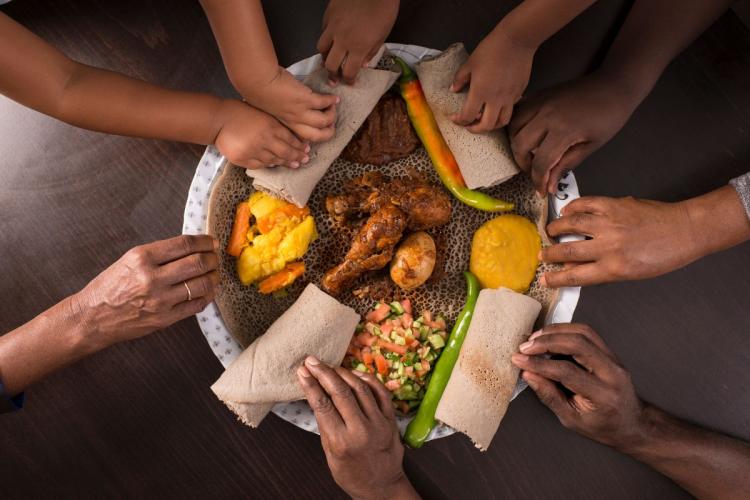
A jebena, the round clay coffee pot with the long neck, if you want to do the coffee ceremony properly. And a sahan, the wide shallow platter that a communal meal is served on, though a large round tray does the same work.
A note on spelling
You'll see the same ingredient spelled several ways, and none of them is wrong. Amharic descends from Ge'ez and has its own script, with sounds that don't map neatly onto Latin letters, so there's no standard transliteration. The spiced butter on this page is niter kebbeh; you'll also meet it as nit'ir qibe and half a dozen other forms. Search for the one that doesn't work and try another.