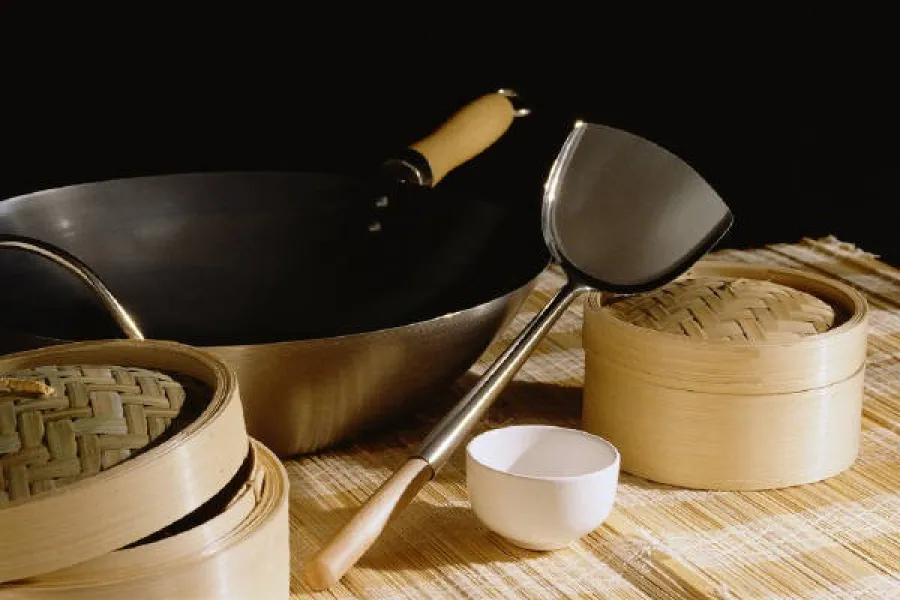
If a single cooking tool stands above all others in Chinese cuisine, it is the wok.
Simple in design yet mighty in usefulness, this rounded metal bowl has been at the heart of Chinese cooking for many centuries, and it remains one of the most versatile tools a modern cook can own. Behind that simplicity lies real depth — a shape refined over generations, a technique that takes years to master, and a flavor, prized above all others in Cantonese cooking, that no other pan can produce.
Where the wok comes from
The word wok is Cantonese and means, simply, "cooking pot." In Mandarin the same vessel is called guō, and related round-bottomed pans appear across Asia under many names, including the South Asian karahi and the Southeast Asian kuali.
The wok's exact origins are debated. Small pottery models of round-bottomed pans have been found in Chinese tombs of the Han dynasty (roughly 200 BC to 200 AD), and the wok is often said to date from this period — though scholars disagree about whether those early vessels were true woks or ancestors of them. What is clearer is the logic that shaped the pan. It was developed in a world where fuel was scarce and a whole meal often had to be cooked over a single small fire. The wok's thin walls and deep, curved base made the most of that limited heat, conducting it quickly and evenly, while finely cut ingredients cooked in moments. The design and the cooking style evolved together: cut small, cook fast, waste nothing.
Wok hei: the breath of the wok
Ask a Cantonese cook what sets a great stir-fry apart and the answer will be wok hei — literally "the breath of the wok." It is the smoky, seared, almost charred aroma that briefly cloaks a stir-fry cooked over fierce heat in a well-seasoned wok. Think of the flavor a burger picks up over a charcoal grill; wok hei is the stir-fry equivalent, and it fades within minutes of the food leaving the pan.
Wok hei is difficult to achieve and is often used as a measure of a chef's skill. It depends on several things coming together at once: a seasoned carbon steel or cast iron wok with a good patina, heat far more intense than most kitchens can produce, a small quantity of food so the temperature does not drop, and constant, rapid tossing so the food sears without burning. In restaurant kitchens, the burner roars and flames leap up over the rim as the cook flips the contents; the effect is part science, part art, part theatre.
It is worth knowing that wok hei belongs to stir-frying alone. When you steam, boil, or braise in a wok, you will not produce it — and not every Chinese dish calls for it. But for the quick stir-fries at the heart of Cantonese cooking, it is the quality that separates the ordinary from the memorable.
One pan, many techniques
The wok's high, sloping sides and intensely hot base make it the ideal shape for stir-frying, letting the cook swirl food rapidly through the heat with little oil and little risk of it flying out. But stir-frying is only the beginning. The same pan handles a remarkable range of techniques:
- Boiling and poaching — chicken, duck, and other fowl are often gently cooked this way.
- Steaming — with a rack and a lid, or a bamboo steamer set inside, the wok steams fish, vegetables, and dumplings beautifully.
- Deep-frying — the curved shape reaches a good depth of oil with less splatter than a flat pan.
- Braising and searing — meats are frequently seared in the wok before being finished by another method.
Jiao zi — Chinese dumplings — can be cooked in a wok by several of these methods, boiled, steamed, or pan-fried, which is part of why the wok is so central to the Chinese kitchen: one pan does the work of many.
Beyond China
Though the wok is inseparable from Chinese cooking, its usefulness has carried it across borders. Versions of the pan are fundamental to Thai, Vietnamese, Malaysian, Indonesian, and Korean kitchens, and its close relative the karahi is a staple of Indian and Pakistani cooking. Wherever fast cooking over high heat is valued, some form of the wok tends to appear. In recent decades it has found a home in kitchens worldwide, embraced by cooks far beyond Asia for exactly the qualities that made it valuable two thousand years ago: speed, efficiency, and versatility.
With the right pan and a little practice, any cook can learn to use one well. For a practical guide to choosing, seasoning, cooking with, and caring for a wok, see our companion page, The wok.