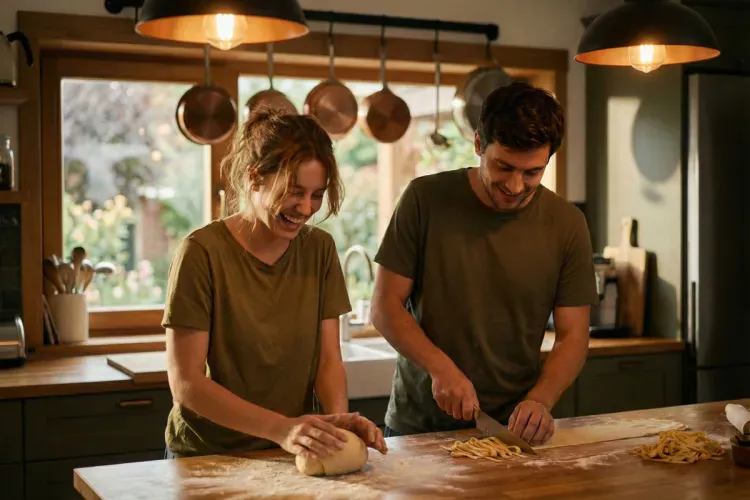
We’ve all been there: sitting in a crowded restaurant on a Friday night, shouting over the ambient noise just to ask your partner how their day was, while nervously eyeing the bill that’s about to land on the table. Don’t get me wrong, I love a night out on the town as much as the next food lover. But sometimes, the most romantic table in the city isn’t at a Michelin-starred bistro—it’s right in your own kitchen.
There is a unique kind of magic that happens when you tie on an apron and invite someone into your culinary space. It’s vulnerable, it’s collaborative, and yes, it can be incredibly sexy. Whether you’ve been married for ten years or are just getting to know someone new, cooking together strips away the distractions of the outside world. It forces you to slow down, communicate, and create something beautiful (and delicious) from scratch.
In this guide, we’re going to trade the reservations for recipes. We’ll explore why sharing a kitchen is the ultimate bonding experience, how to set the mood, and walk you through a hands-on menu designed to spark connection—from handmade pasta to a decadent chocolate fondue.
The intimacy of sharing a kitchen space
Have you ever noticed how, at every house party, everyone eventually ends up in the kitchen? It’s the heart of the home for a reason. But when it’s just the two of you, that space transforms into something more intimate.
Cooking is an act of trust. You are working in a confined space, moving around each other in a coordinated dance (hopefully without bumping into too many counters!). You’re tasting, smelling, and touching ingredients. It’s a sensory experience that naturally encourages closeness.
Psychologists and relationship experts have long noted the benefits of shared activities. According to the UK Time Use Survey, couples who eat together are significantly more likely to report happiness in their relationships. But the benefit starts before the fork even hits the plate. The act of "commensality"—eating together—is a ritual that signals bonding and shared identity. When you cook together, you aren't just consumers of a meal; you are co-creators. You are building a small, delicious world that belongs only to the two of you.
Plus, let’s be honest: seeing your partner master a skill, whether it’s expertly chopping vegetables or kneading dough, is attractive. It shows competence, care, and creativity. And if things go wrong? If the sauce breaks or the onions burn? That’s where the real bonding happens. Laughing over a kitchen mishap is a far better memory than suffering through a stiff, silent dinner at a restaurant.
Preparing your kitchen for a romantic evening
Before you start chopping, you need to set the stage. You wouldn't invite a date to a restaurant with harsh fluorescent lighting and a cluttered table, so don't do it at home!
Clear the decks: A romantic cooking session requires counter space. Put away the mail, the toaster, and the dirty dishes from breakfast. You want a clean canvas.
Lighting is key: Turn off the big overhead light. Use under-cabinet lighting, warm lamps, or even safe placement of candles (away from the stove!) to create a soft glow.
The soundtrack: Music is essential. Create a playlist that is upbeat enough to cook to, but mellow enough to talk over. Think smooth jazz, acoustic covers, or classic soul.
Mise en place: This is a French culinary term meaning "everything in its place." Pre-measure your ingredients before you start cooking. This prevents the stress of frantically searching for the cumin while the garlic burns. It allows you to focus on each other, rather than the logistics.
Hands-on recipes: the fun of making pasta from scratch
If we’re going for romance, we need a dish that requires tactile engagement. Steak is great, but it’s mostly just watching a pan sizzle. Pasta, on the other hand, is an activity.
Making fresh pasta from scratch is a labor of love. It requires you to get your hands messy, to feel the texture of the dough, and to work together to roll it out. It’s impressive, delicious, and surprisingly forgiving.
Fresh egg pasta dough
Prep time: 45 minutes | Cook time: 4 minutes | Serves: 2
Ingredients
- 2 cups (approx. 290g) '00' pasta flour or all-purpose flour
- 3 large eggs, room temperature
- 1/2 teaspoon salt
- Semolina flour (for dusting)
Instructions
- The well: Pour the flour onto a clean work surface (a wooden board is ideal). Make a wide well in the center of the flour, looking like a volcano. Crack the eggs into the well and add the salt.
- The scramble: Using a fork, gently whisk the eggs within the well. Slowly start incorporating the flour from the inner walls of the well, being careful not to break the wall (or you’ll have an egg-scape!).
- The knead: Once the dough starts to come together and is too thick to whisk, use your hands or a bench scraper to fold in the rest of the flour. Form a ball. Now, the fun part: knead the dough. Push it away from you with the heel of your hand, fold it back, and turn. Do this for about 10 minutes until the dough is smooth and elastic. Tip: Take turns kneading! It’s a workout.
- The rest: Wrap the dough tightly in plastic wrap and let it rest at room temperature for at least 30 minutes. This relaxes the gluten, making it easier to roll.
- The roll: Cut the dough in half. Flour your surface. If you have a pasta machine, pass the dough through the widest setting, fold it in thirds, and pass it through again. Gradually decrease the width until you have a thin sheet. If rolling by hand, use a rolling pin to get it as thin as a playing card.
- The cut: Cut into fettuccine or tagliatelle strips. Dust with semolina to prevent sticking and form into loose nests.
- The cook: Drop into salted boiling water for just 3-4 minutes until al dente.
Tips and suggestions
If the dough feels too dry, wet your hands and keep kneading. If it's too sticky, add a dusting of flour. Pair this with a simple brown butter and sage sauce, or a light marinara, so you don't overpower the delicate fresh egg flavor.
Simple but impressive recipes for two
While the pasta is your "main event" activity, you don't want to spend the entire night laboring over every single course. Balance is key. Here are a few ideas to round out the meal without adding stress.
Starter: Roasted caprese crostini
Instead of a cold salad, warm things up. Slice a baguette, brush with olive oil, and toast until golden. Top with cherry tomatoes that have been roasted with balsamic glaze until they burst, and finish with a slice of fresh mozzarella and basil. It’s messy, flavorful, and perfect for feeding each other a bite.
Side: Lemony asparagus ribbons
Since you are making rich pasta, you need something bright and acid-forward to cut through the heaviness. Use a vegetable peeler to shave raw asparagus into long, thin ribbons. Toss with lemon juice, olive oil, shaved parmesan, and toasted pine nuts. It takes five minutes and looks incredibly elegant.
Pairing the perfect wine
We know that for many of you the wine is just as important as the food. Choosing the right bottle can elevate a home-cooked meal into a dining experience.
Since we are making fresh egg pasta, likely with a lighter sauce (like butter/sage or a simple tomato basil), you want a wine that complements rather than dominates.
If you choose a Tomato Sauce: Go for a medium-bodied Red with good acidity. A Chianti Classico (Sangiovese grape) is the classic "what grows together goes together" pairing. The acidity in the wine matches the acidity in the tomatoes.
If you choose Butter/Sage or Cream: You need a white wine with some body to stand up to the fat, but enough zest to cleanse the palate. An oaked Chardonnay or a high-quality Viognier works beautifully here.
If you want bubbles: You can never go wrong with Prosecco or Franciacorta for a date night. The effervescence cuts through the richness of the egg pasta and feels celebratory.
Pro Tip: Don't just pour the wine; taste it together. Swirl the glass, smell the notes, and discuss what you pick up. Is it cherry? Vanilla? Wet stone? It’s another way to engage your senses together.
Interactive desserts: why chocolate fondue is the perfect finish
You’ve made the pasta, you’ve enjoyed the wine. Now, for the finale. You want something sweet, but you don't want to start baking a cake at 9:00 PM. Enter: Chocolate Fondue.
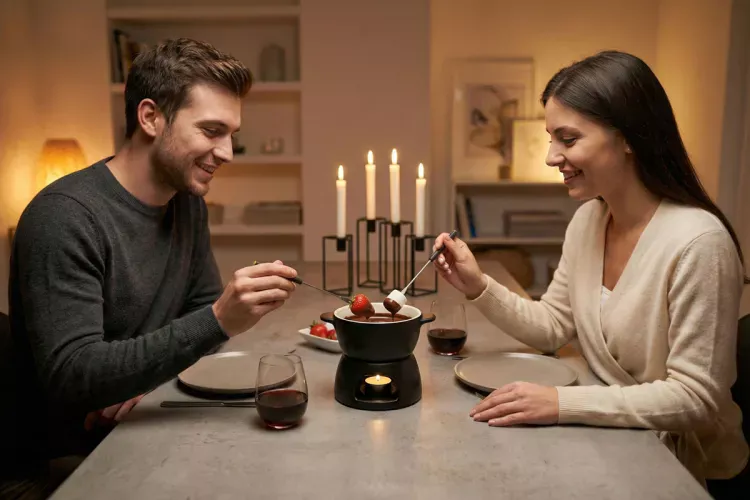
It’s retro, it’s fun, and it is arguably the most romantic dessert in existence. It requires zero baking skills and encourages lingering at the table.
Classic chocolate fondue
Prep time: 10 minutes | Cook time: 5 minutes | Serves: 2
Ingredients
- 8 oz semi-sweet or bittersweet chocolate (high quality, chopped)
- 1/2 cup heavy cream
- 1 tsp vanilla extract
- Pinch of sea salt
- Dippers: Strawberries, banana slices, marshmallows, pound cake cubes, pretzels (for that sweet/salty combo).
Instructions
- Heat the Cream: In a small saucepan, warm the cream over medium heat until it just begins to simmer. Do not let it boil over.
- Melt: Remove from heat and immediately add the chopped chocolate. Let it sit for 2 minutes.
- Whisk: Gently whisk the mixture until the chocolate is completely melted and glossy. Stir in the vanilla and salt.
- Serve: Transfer to a fondue pot or a warm ceramic bowl. Arrange your dippers on a platter and dive in.
Variations
Boozy Fondue: Add a tablespoon of Grand Marnier, Amaretto, or Baileys for a kick.
Mexican Chocolate: Add a pinch of cinnamon and a tiny dash of cayenne pepper for some heat.
How to keep the mood light and engaging
The biggest killer of romance in the kitchen is stress. If you are trying to execute a recipe that is too complex, or if you are worried about the mess, the fun evaporates.
Embrace the mess: Flour will get on the floor. Chocolate might drip on the counter. It’s okay. Clean it up later, together.
Touch often: Use the close quarters to your advantage. A hand on the back as you squeeze behind them to get to the fridge, or a quick hug while waiting for the water to boil, keeps the physical connection alive.
Keep tasting: Feed each other spoonfuls of the sauce to check the seasoning. Ask for their opinion. "Does this need more salt?" "What do you think about adding chili flakes?"
Ditch the phone: Unless you are using it for the recipe (or snapping one quick photo of your pasta masterpiece), keep the screens away. This is your time.
Building lasting memories through culinary collaboration
At the end of the night, the goal isn't just a full stomach. It’s the memory of the evening. Years from now, you might not remember exactly how the pasta tasted, but you will remember the way you laughed when the flour cloud exploded, or the conversation you had over the simmering sauce.
Cooking together is a celebration of the present moment. It’s a declaration that you are willing to put in the time and effort to nurture not just your bodies, but your relationship. So, this week, skip the reservation. Open a bottle of wine, turn on the music, and fall in love all over again—right there in your kitchen.