
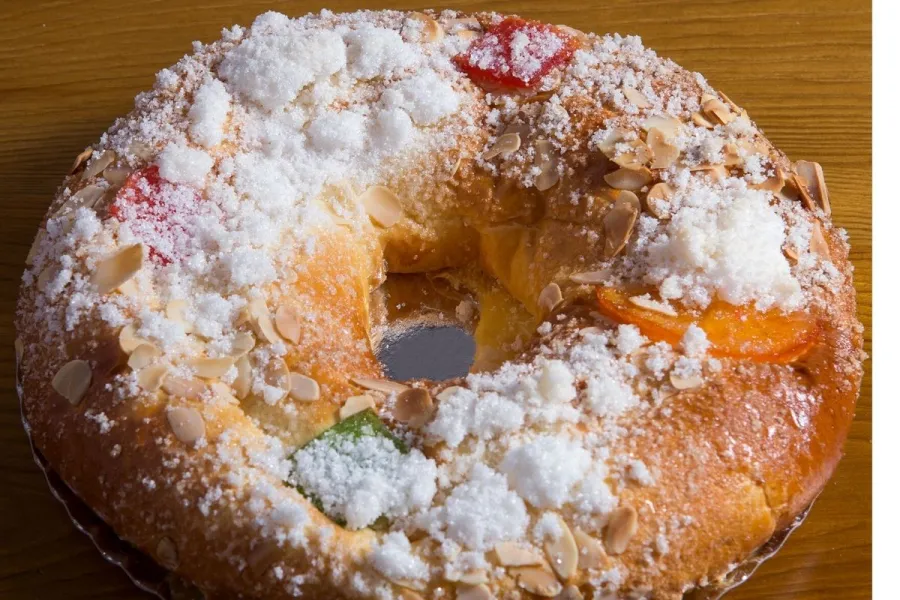
This beautiful, crown-shaped brioche is the centerpiece of Three Kings' Day (Epiphany) celebrations across Spain. While it requires a bit of patience for the dough to rise, the result, a tender, airy crumb decorated like a jeweled crown, is absolutely worth the wait.
Ingredients
Instructions
Activate the pre-ferment
To get that lovely, airy texture, we start with a sponge. In a small bowl, dissolve 1 teaspoon yeast and 1 teaspoon sugar in 1/2 cup warm milk. Stir in 3/4 cup flour. Cover this mixture with plastic wrap and let it sit in a warm, draft-free spot for about 15-20 minutes until it becomes bubbly and foamy.
Infuse the sugar
While the sponge is activating, place 1/2 cup granulated sugar in a bowl with the orange and lemon zest. Rub the zest into the sugar with your fingertips. This releases the essential oils and will make your Roscón incredibly fragrant.
Mix the dough
In the bowl of a stand mixer fitted with a dough hook (or a large bowl if mixing by hand), combine the zest-infused sugar, the rest of the flour, salt, 2 eggs, 1/3 cup warm milk, orange blossom water, 2 teaspoons dry yeast, and your activated sponge mixture.
Mix on low speed until combined. Once the dough starts to come together, add the softened butter bit by bit. Knead for about 10-15 minutes. The dough will be sticky at first—don’t panic! Keep kneading until it becomes smooth, elastic, and pulls away cleanly from the sides of the bowl.
The first rise
Form the dough into a ball and place it in a lightly oiled bowl. Cover with a cloth or plastic wrap. Let it rise in a warm place for about 2 hours, or until it has doubled in size.
Shaping the crown
Once doubled, gently punch the dough down to release the air. Place it on a lightly floured surface and form it into a smooth ball again. To create the classic ring shape, poke a hole in the center with your fingers and gently stretch the dough outward, rotating it as you go, until you have a large ring (like a giant donut). Place the ring on a baking sheet lined with parchment paper.
Tip: The hole should be quite large, as it will shrink back up when the dough rises again.
Hiding the surprises
If you are including the traditional figurine and bean, now is the time! Lift the dough slightly from the bottom and tuck the wrapped figurine and bean into different sections of the dough. Smooth the dough over so no one can see where they are hidden.
The second rise
Cover the shaped Roscón loosely with a clean towel and let it rise again for about 45 minutes to an hour. It should look puffy and soft.
Decoration
Heat your oven to 375°F (190°C).
Beat the remaining egg and brush the dough gently with the beaten egg. This gives it a brilliant golden shine. Decorate your "crown" with the candied fruits, pressing them slightly into the dough. Sprinkle generously with the pearl sugar (or wet sugar) and sliced almonds if using.
Bake
Bake for 20-25 minutes. Keep an eye on it—if it starts browning too quickly, you can tent it loosely with aluminum foil for the last 10 minutes. It is done when it is a deep golden brown and sounds hollow when tapped on the bottom.
Serving
Let the Roscón cool completely on a wire rack.
Notes
If you are including the traditional figurine and bean and it is something that will not be altered while in the oven, do it when you have shaped the crown. Lift the dough slightly from the bottom and tuck the wrapped figurine and bean into different sections of the dough. Smooth the dough over so no one can see where they are hidden.
The king and the bean
Part of the magic of the Roscón lies hidden inside the dough. Traditionally, two small items are tucked into the cake before baking:
- The figurine: Usually a small ceramic king or a baby Jesus. Finding this is a stroke of good luck! The person who discovers the figurine in their slice is crowned the "King" or "Queen" of the banquet.
- The dry bean (el haba): Tradition dictates that whoever finds the dry fava bean must pay for the Roscón the following year. It’s a fun, playful way to keep the tradition alive among family and friends.
(If you are serving this to small children, please be careful with small objects or wrap them in foil/parchment paper to make them more visible.)
Source
Food in Europe