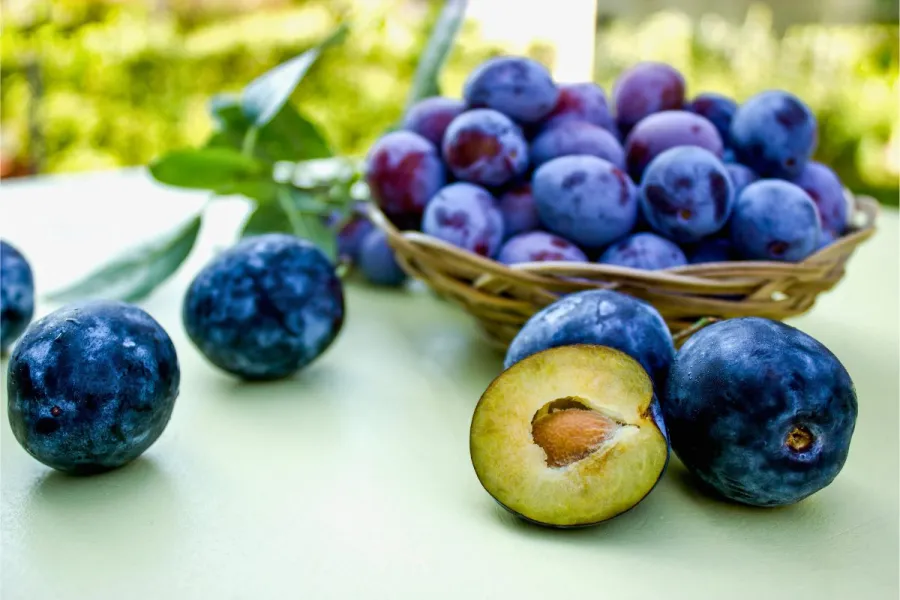
Well, it’s not really new, but a damson plum is a lesser known variety than others, so it may be new to you.
The damson is actually one of many varieties of plum. The fruit is produced from deciduous trees that blossom with little white flowers in early spring in the northern hemisphere, then the fruit is harvested in late summer to early fall.
There are several varieties of damson, each of which has a slightly different color and taste. The Shropshire damson, for instance, has a mildly acidic taste while the Merryweather damson has a sweeter flavor, more closely resembling the plums most often found in the produce aisle. It’s hard to pinpoint one particular flavor of damson because they vary so much. Damsons have a firm green or golden yellow flesh and a rich dark blue, red, or purple skin. It can be either sweet or tart, depending on which variety of the fruit you choose. The blue damson plum, for example, is known for its late-summer to fall harvest window, rich nutrient profile, and unique flavor, making it ideal for jams and desserts. Damsons all tend to be oval shaped, slightly pointy at one end.
Damson plums are a delightful discovery
Plums generally are documented as long as 2,000 years ago. Early documentation places the damson cultivation in the region surrounding Damascus, thus the name Damson, and were most likely introduced into England by the Romans. While the damson plum is often associated with European plums, it is classified as a separate species by botanists. It is not known when damson plums were introduced into North America, but some site colonists most likely brought them during the first settlements.
Evidence of damsons have been found in Roman archaeological digs across England and there is even evidence of damson skins being used to produce purple dye during those ancient times. The Blue Damson Plum Tree is known for producing consistent heavy crops of heirloom plums, which are cherished for their distinct flavor and increasing rarity in grocery stores.
Damson plums can be made into gin, in the same way as sloe gin is made from a relative of the plum, the sloe berries. Sloe gin requires more sugar because damsons are sweeter than sloe berries. Another spirit made with damson plums is Slivovitz, which is a distilled drink made in Slavic countries. Some people also make a simple damson wine. Because many varieties of damson are quite tart and acidic, people found other uses than eating them right off the tree. That’s why you’ll find all sorts of recipes for damson fruit liqueurs, vodka, gin, and wine.
Preparation and cooking
As mentioned, the damson plum taste when eaten right from the tree can be a bit unpalatable as the skins can be quite tart, making it less suitable for fresh eating. Because of this, most damson plums are grown to make damson jelly or jam. There are, however, at least a few varieties of damson cultivated for eating off the tree. The Merryweather and President Plum are two of such damsons. A variety called Farleigh is best known as a cooking plum.
Some damson fans have developed wonderful recipes for pickling and canning. For canning purposes, the damson fruit is boiled until tender. Then, sugar and allspice can be added when the water in the fruit has been reduced. As you continue to boil the fruit, it becomes very thick and can then be poured into jars and processed.
If you choose the sweeter variety of damson fruit, you can also make a very good pie as well as a delicious compote for tarts, or mixed with cream cheese for a delightfully sweet spread for crackers. Juicy plums from the damson tree are particularly well-suited for home canning. Damsons are also used to make things like chutney, cobbler, and a variation of Eve’s Pudding, which is traditionally made with apples. The intense flavor of the fruit also can be taken advantage of successfully in sauces and stuffings for roast duck and other wild game who’s flavor can stand up against the damson.
If you can find damson plums in your local store, it’s worth giving this fruit a try. Its acidic qualities and strong flavors may perk up your next entrée or dessert quite nicely. And when your dinner guests ask what that delightfully fresh flavor is, go ahead and throw out the name Damson and see what happens. Perhaps it will spark a lively conversation and a few puzzled, but pleased, looks!
Substitutions: Usually, 1 lb fresh damson plums will yield 2 1/2 cups sliced fruit or 2 cups cooked. If you don’t have them, substitute 1 lb damson plums with:
- 1 lb Mirabelle plums, also sweet-tart flavor
- 1 lb greengages - different color, sweet-tart flavor
- 1 lb plums - porbably sweeter flavor
- 1 lb tart cherries
- 1 lb pluots, a hybrid of plum and apricot