Food has always been more than something to eat. Long before cookbooks existed, long before food photography, and long before Instagram plates, artists were painting, carving, and decorating with food. From the cave walls of prehistoric Europe to a contemporary gallery in New York, food appears in art in every era, in every culture, and for an extraordinary range of reasons.
Sometimes food in art is about abundance. Sometimes it is about hunger. It can mark a religious moment, celebrate a trade route, or quietly say something about who holds power at the table and who does not. A single painted lemon can carry meanings that have nothing to do with lemonade.
This page is your guide to food in art across time. Below you will find an overview of how food has been used by artists from prehistory to the present, the themes that keep appearing across centuries, and a full series of pages that take you deeper into each period.
What counts as food in art?
Most people, when they think of food in art, picture a Dutch still life: a spread of oysters, wine, bread, and fruit arranged on a cloth-covered table, painted with astonishing skill. That image is not wrong, but it is only one part of the story.
Food appears in art in many forms that have nothing to do with a formal still life arrangement. Still life — paintings where the primary subject is inanimate objects, usually arranged on a table — is one branch of this topic, not the whole of it.
Food in art also includes:
- Hunting and fishing scenes from caves and tombs
- Offering tables piled with bread, beer, and fruit in Egyptian tomb paintings
- Greek vases showing banquets, wine pouring, and sacrificial feasts
- Medieval manuscript illustrations of harvest labor and courtly feasting
- The bread and wine of the Last Supper in Renaissance altarpieces
- Market scenes bursting with vegetables, game, and fish in 16th-century Flemish painting
- Kitchen interiors where servants prepare food that never appears on the table
- Andy Warhol's Campbell's soup cans printed in rows like supermarket shelves
- Contemporary installations where the food itself is the medium
In other words, whenever an artist puts food into a work — whether as the main subject, a symbolic detail, or the raw material of the piece — that is food in art. The subject is far wider, and more interesting, than still life alone.
Food in art through history
Food has appeared in art for as long as humans have been making it. What changes across time is what food is being used to say.
Prehistoric art (before 3000 BCE)
The earliest food imagery is about survival. Cave paintings across Europe and Africa show animals hunted for meat — bison, deer, mammoths — painted with remarkable accuracy and energy. These were not decorations for pleasure. They were connected to the lives, rituals, and beliefs of the people who made them. Food here is raw, essential, and tied to the natural world.
Ancient civilizations (3000 BCE – 500 CE)
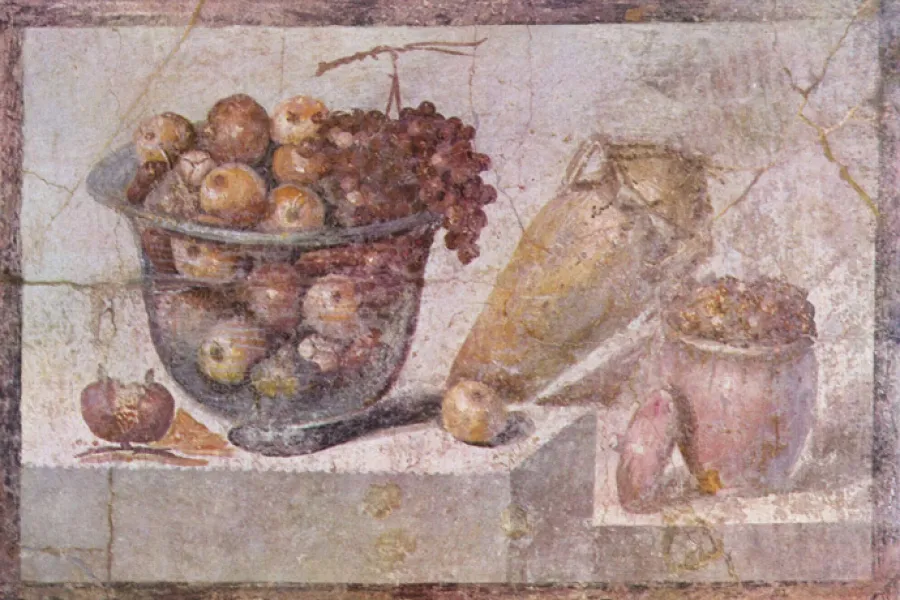
In ancient Egypt, Mesopotamia, Greece, and Rome, food in art becomes ceremonial and social. Egyptian tomb paintings fill entire walls with scenes of bread-baking, beer-making, fishing, and harvest — provisions for the afterlife. Greek vases celebrate the symposium, the male drinking gathering where wine and hospitality defined social relationships. Roman frescoes and mosaics cover dining room walls with painted feasts and the famous "unswept floor" designs scattered with leftover scraps and shells — a visual joke about the abundance of the meal just eaten.
Early Christian and Medieval art (500 – 1400 CE)
When the Roman Empire gave way to Christian Europe, food imagery became deeply symbolic. Bread, wine, fish, grapes, and lamb all carry Eucharistic meaning — references to Christ, salvation, and the sacraments. The Last Supper becomes one of the most painted moments in history. Meanwhile, Books of Hours and illuminated manuscripts track the agricultural year month by month: sowing, harvesting, feasting, and fasting. Food here is spiritual before it is sensory.
Renaissance art (1400 – 1600)
Renaissance artists brought a new spirit of observation to everything, including food. Painters began to look closely at the actual texture of a crust, the translucence of a grape, the way light falls on a pewter jug. Food in religious paintings became more naturalistic. Market and kitchen scenes — enormous, chaotic, overwhelming — appeared for the first time as major paintings in their own right. The still life as an independent subject began to take shape.
Baroque and Dutch Golden Age art (1600 – 1700)
This is the great age of food in European painting. Dutch artists in particular made food imagery into an art form of extraordinary technical ambition. Breakfast pieces, banquet paintings, and the lavish pronkstilleven — literally "ostentatious still life" — display bread, oysters, lobsters, lemons, wine, and imported spices with dazzling realism. But underneath the abundance lies a moral message: this beauty will not last. Overturned glasses, half-eaten food, and wilting flowers remind the viewer that pleasure is fleeting. This tension between enjoyment and mortality is known as vanitas.
18th century art (1700 – 1800)
The 18th century divides into two moods. In France, the Rococo style brought elegance, lightness, and social pleasure — refined dining rooms, tea services, and the new fashionable drinks of tea, coffee, and chocolate. In contrast, Jean-Baptiste-Siméon Chardin painted humble kitchen still lifes with radical simplicity: a copper pot, a few vegetables, a loaf of bread. His work was a quiet argument that modest food, painted honestly, was as worthy of art as any aristocratic feast.
19th century art (1800 – 1900)
The 19th century brought art face to face with real life in a new way. Realist painters showed peasants eating plain meals in difficult conditions. Urban Impressionists painted cafés, luncheons on the grass, and the new restaurant culture of Paris. Cézanne spent decades painting apples and pears in arrangements that had nothing to do with appetite and everything to do with the geometry of space — work that would change the course of Western art entirely.
Modern and 20th-century art (1900 – 1980)
The 20th century breaks food imagery apart and rebuilds it. Cubist painters like Braque and Picasso shatter the fruit bowl into multiple viewpoints at once. Surrealists use food as a source of strangeness and psychological unease. Then Pop Art arrives: Andy Warhol prints Campbell's soup cans in rows of thirty-two, Claes Oldenburg sculpts enormous soft hamburgers and ice cream cones, and food becomes a language for talking about consumer culture, mass production, and advertising. Domestic critics in the later 20th century turn the kitchen into a political space.
Contemporary art (1980 – present)
Today, artists use food as medium, performance, and statement. Food installations fill galleries with real ingredients that decay over the run of an exhibition. Participatory dinners become artworks where the meal itself is the piece. Artists from migrant and diaspora backgrounds use the foods of their homelands to explore memory, identity, and belonging. Others work with food systems, waste, and ecological collapse. In contemporary art, food has moved from object to argument.
Explore each period in detail
This series covers the full history of food in art, from the earliest human mark-making to works being created today. Each page focuses on one period, with examples, key artists, and a guide to what the food in those works actually means.
Wherever you choose to begin, you will find that the food in the image says something worth hearing. Look closely, and it will tell you a great deal about the people who made it, the world they lived in, and how they understood what it means to eat.